

IPSS prostate symptom score
Answer the seven AUA symptom index questions and the quality of life question, and see your symptom total out of 35 with its published range. The questionnaire is reproduced word for word, it runs entirely in your browser, and it is a screen rather than a diagnosis. For adults with a prostate.
Medically reviewed by Kevin Brandstetter, M.D.Updated September 28, 2026
AUA BPH Symptom Score
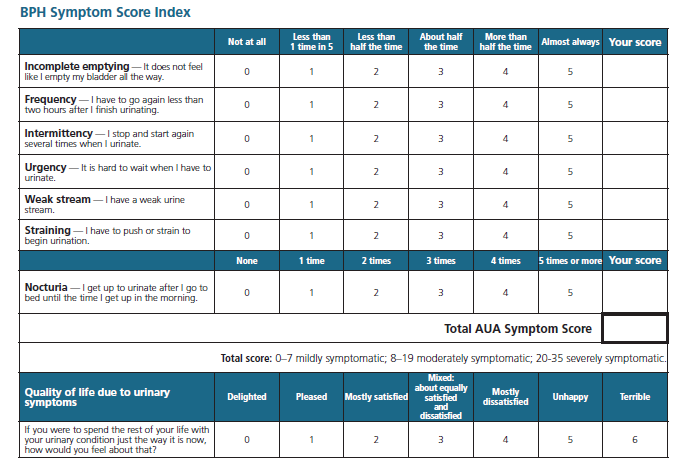
1. Over the past month, how often have you had a sensation of not emptying your bladder completely after you finished urinating?
2. Over the past month, how often have you had to urinate again less than two hours after you finished urinating?
3. Over the past month, how often have you found you stopped and started again several times when you urinated?
4. Over the past month, how often have you found it difficult to postpone urination?
5. Over the past month, how often have you had a weak urinary stream?
6. Over the past month, how often have you had to push or strain to begin urination?
7. Over the past month, how many times did you most typically get up to urinate from the time you went to bed at night until the time you got up in the morning?
Quality of life due to urinary symptoms
If you were to spend the rest of your life with your urinary condition just the way it is now, how would you feel about that?
Your IPSS symptom score
Incomplete
0 of 7 answered
Answer all seven symptom questions to see the score. A partly answered questionnaire has no score of its own.
A score is a screen, not a diagnosis. The next step is a conversation with a licensed clinician, who reads a number like this alongside your history, not on its own.
A screen, not a diagnosis.
The IPSS asks how often common urinary symptoms have happened over the past month. It cannot tell what is causing them, and many different conditions produce the same symptoms. Only a licensed clinician can make a diagnosis, and they read a score alongside your history and an exam, not instead of them. This tool is for adults with a prostate; the questionnaire was developed in men with benign prostatic hyperplasia.
Get urgent care now if you cannot urinate at all, or if you have blood in your urine, fever with pain when urinating, or pain in your side or back.
Methodology
- How this is calculated
- Each of the seven symptom questions scores 0 to 5, by the column its answer sits in. The seven are added for a symptom total between 0 and 35, which falls in one of three published ranges. The quality of life question scores 0 to 6 and is reported on its own, never added to the total. No total appears until all seven symptom questions are answered, because a partly answered questionnaire has no score.
- Where the data comes from
- The questionnaire was published as: Barry MJ, Fowler FJ Jr, O'Leary MP, Bruskewitz RC, Holtgrewe HL, Mebust WK, Cockett AT. The American Urological Association symptom index for benign prostatic hyperplasia. The Measurement Committee of the American Urological Association. J Urol. 1992;148(5):1549-57. doi:10.1016/s0022-5347(17)36966-5. The seven questions, their answer choices, and the quality of life question are reproduced word for word from Appendix 1-A of the American Urological Association's BPH guideline. The seven quality of life answer labels and the three ranges are read from the Urology Care Foundation's BPH symptom score sheet, the American Urological Association's patient foundation; the ranges were confirmed against that sheet, not against the full text of the 1992 paper. The I-PSS is in the public domain (Mapi Research Trust, ePROVIDE); Temi reproduces the published instrument with citation.
- Last updated
- September 28, 2026
- What this does not account for
- Everything a clinician asks and checks beyond these questions: how long the symptoms have gone on, pain, blood in the urine, fluid intake and caffeine, your other conditions, your medications, and an exam. The score says how often symptoms happen, not what causes them, and the published ranges are three bands of the total with no single threshold, so this tool reports the range and nothing more.
What the ranges mean
The Urology Care Foundation's score sheet sorts the symptom total into the three ranges below, in its own words. The badge beside a score on this page uses one shorter word for each, because a range of a score is not a statement about the person who scored it.
| Score | The sheet's wording | Badge on this page |
|---|---|---|
| 0 to 7 | mildly symptomatic | Mild |
| 8 to 19 | moderately symptomatic | Moderate |
| 20 to 35 | severely symptomatic | Severe |
Why quality of life is not in the score
The IPSS is the American Urological Association's seven symptom questions plus one more, the question under “Quality of life due to urinary symptoms”. That question asks how much the symptoms bother you rather than how often they happen, and it is scored on its own scale from 0 to 6. The symptom total and the ranges use the seven symptom questions only, so this page shows the quality of life answer beside the total rather than inside it.
Why the wording is not edited
The IPSS is a validated questionnaire: its ranges mean what they mean because large numbers of people answered these questions in this wording. Shorten a question or soften a phrase and the score is no longer the score the research is about. So the questions and the answer choices here are reproduced exactly as the American Urological Association and its Urology Care Foundation print them, rather than rewritten in Temi's voice the way the rest of this page is.
Nothing here is stored
Your answers stay in your browser. They are not sent to Temi, not saved, not attached to you, and not recorded in any session replay, and closing the tab clears them. Temi knows only that someone opened this tool, the same thing it knows about every page.
Copying the result link is the one way answers leave your browser, and you decide when. The link carries all eight answers in the part of the address after the “#”, which browsers never send to a web server, so Temi still never sees a score. Anyone holding the link can open it and read the answers, so send it only to someone you mean to show.
If you want to act on what you see, the useful next step is a conversation with a clinician who knows you, or one you can get to.
More free tools
- GLP-1 cost calculatorSee the whole monthly cost, itemized.
- Dose to units calculatorTurn a milligram dose into a syringe reading.
- GLP-1 eligibility checkerSee where you stand before you start.
- Refill and renewal checkerFind out whether you need a refill or a renewal.
- Titration schedule plannerPut the standard dose steps on real dates.
- PHQ-9 depression screeningScore the standard nine-question depression screen.
- GAD-7 anxiety screeningScore the standard seven-question anxiety screen.
- PHQ-2 depression pre-screenTwo questions before the full depression screen.
- BMI calculatorSee your BMI and the WHO category it falls in.
- Daily calorie needs calculatorEstimate the calories it takes to maintain your weight.
- Ideal body weight calculatorSee the weight the Devine equation returns for your height.
- Pregnancy due date calculatorTurn a known date into an estimated due date.
- Creatinine clearance calculatorEstimate creatinine clearance from the Cockcroft and Gault equation.
- eGFR calculatorEstimate GFR from the race-free CKD-EPI 2021 equation.
- A1c to average glucose converterTurn an A1c into an estimated average glucose, or back.
- Mean arterial pressure calculatorSee the mean arterial pressure from a blood pressure reading.
- LDL cholesterol calculatorEstimate LDL cholesterol from a standard lipid panel.
- ASCVD 10-year risk calculatorEstimate 10-year cardiovascular risk with the AHA PREVENT equations.
- Insomnia Severity IndexScore the standard seven-item insomnia questionnaire.
- Geriatric Depression Scale (GDS-15)Score the fifteen-question yes or no mood scale for older adults.
- PC-PTSD-5 screenScore the five-question PTSD screen from the VA.
- mMRC dyspnea scaleFind the grade that matches your breathlessness.
- Waist-to-hip ratio calculatorSee your waist-to-hip ratio beside the WHO cut-off.
- Body Roundness Index calculatorSee the Body Roundness Index for your height and waist.
- Pack-years calculatorTurn a smoking history into pack-years.
Already taking a medication?
Temi's physicians review renewals for non-controlled medications, usually within 48 hours. A score on this page is not a prescription and does not decide anything.
A licensed physician reviews every request. Nothing on this page is a prescription.