

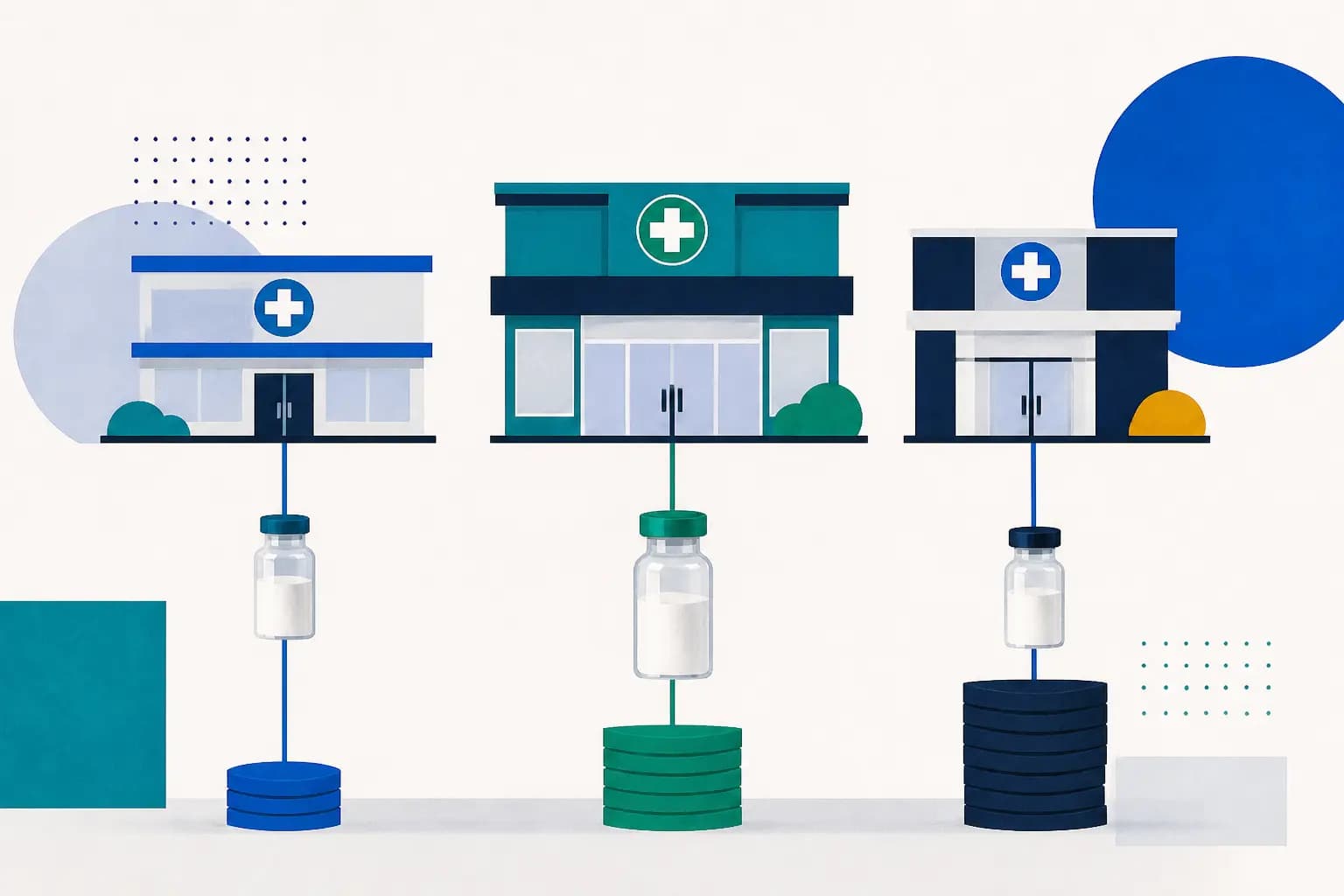
Ask three pharmacies for a 68 mg tirzepatide vial at 17 mg/mL in 4 mL and you get three different prices. Same drug, same concentration, same volume, same total milligrams. The cheapest charges $139.99. The most expensive charges $514.99.
That is not a typo, and it is not a discount. It is the ordinary state of a market where every 503A pharmacy sets its own price and almost nobody publishes them side by side.
Educational information, not a substitute for personalized medical advice.
One thing to be clear about up front: compounded semaglutide and tirzepatide are not FDA approved. Compounded drugs do not go through FDA review for safety, effectiveness, or quality before they are sold, and the FDA's position is that they should be used only in patients whose medical needs cannot be met by an FDA-approved drug. Source: FDA's Concerns with Unapproved GLP-1 Drugs Used for Weight Loss
How wide is the spread, really
Every number in this article is a displayed vial price from Temi's own catalog as of August 2026, for a Florida shipping address unless another state is named. Five compounding pharmacies serve a Florida address today, which is as wide as the comparison gets anywhere. Prices move, so treat these as a snapshot and read the current numbers on the compounded semaglutide and compounded tirzepatide pages.
Here is what the same vial costs at different pharmacies on the same day.
| Vial | Pharmacies offering it | Lowest | Highest | Spread |
|---|---|---|---|---|
| Semaglutide 1 mg | 2 | $74.99 | $124.99 | 1.7x |
| Semaglutide 2.5 mg | 3 | $59.99 | $144.99 | 2.4x |
| Semaglutide 5 mg | 4 | $84.99 | $154.99 | 1.8x |
| Semaglutide 10 mg | 4 | $94.99 | $194.99 | 2.1x |
| Semaglutide 12.5 mg | 3 | $174.99 | $239.99 | 1.4x |
| Tirzepatide 20 mg | 4 | $99.99 | $204.99 | 2.1x |
| Tirzepatide 34 mg | 3 | $119.99 | $334.99 | 2.8x |
| Tirzepatide 68 mg | 3 | $139.99 | $514.99 | 3.7x |
A note on pharmacy names. The names are printed on every offer card in the pharmacy picker, where they stay current. They are left out of this article on purpose: a static price table that names a pharmacy will misquote that pharmacy the first time it changes a price, and the mechanism below is what actually answers the question.
Some of the spread is not a spread at all
Before the real drivers, clear out the false ones. A large share of what looks like a price difference is two pharmacies selling genuinely different things under the same headline number.
Total milligrams are not the product. A 5 mg semaglutide vial can be 1 mL at 5 mg/mL or 5 mL at 1 mg/mL. Across the Florida catalog, four pharmacies sell a 5 mg semaglutide vial in volumes from 1 mL to 5 mL, at three different concentrations. Those are not the same object, and the volume you draw into the syringe for the same prescribed dose is different in each one.
That difference is worth more than money. The FDA has documented adverse events, some requiring hospitalization, from dosing errors with compounded injectable semaglutide, driven by confusion between milliliters, milligrams, and "units," and by the fact that a single compounder may offer multiple concentrations. In most of those reports, patients drew up five to twenty times the intended dose. Source: FDA alert on dosing errors with compounded injectable semaglutide
Shipping is often the invisible variable. GLP-1 injectables need a cold chain and overnight service, and that cost is close to flat per box. It does not care whether the vial holds 1 mg or 68 mg. Some pharmacies quote a delivered price. Others quote the medication and charge shipping separately. Until someone puts both on the same basis, two "semaglutide 5 mg" numbers are not comparable. Every price in this article already includes shipping, which is why they can sit in one column.
The additive is the most visible difference and the least useful one. One label reads semaglutide/B12, the next reads tirzepatide + glycine, a third reads no additive at all. None of it changes the GLP-1 dose you take, and none of it explains the price. We walk through what is actually in the vial in a separate article.
The part that is a real spread
Now strip all of that out. Hold the active ingredient, the concentration, the vial volume, and the total milligrams constant, so two pharmacies are selling a genuinely interchangeable product. The gap does not close.
| Vial | Concentration | Volume | Lowest | Highest | Spread |
|---|---|---|---|---|---|
| Semaglutide 10 mg | 5 mg/mL | 2 mL | $94.99 | $174.99 | 1.8x |
| Tirzepatide 34 mg | 17 mg/mL | 2 mL | $119.99 | $334.99 | 2.8x |
| Tirzepatide 68 mg | 17 mg/mL | 4 mL | $139.99 | $514.99 | 3.7x |
Three times the price for the same specification is not explained by formulation, and it is not explained by shipping. It is explained by the fact that these are independent businesses with different ingredient contracts, different batch sizes, different equipment, different labor, and different views of what the market will pay. A pharmacy compounding at volume against a favorable active-pharmaceutical-ingredient contract has a different floor than one compounding in smaller runs.
It is worth saying plainly that the direction is not consistent, either. Two other pharmacies sell an identical 5 mg semaglutide vial at 5 mg/mL in 1 mL for $149.99 and $154.99. Sometimes the market is tight. Sometimes it is not. You cannot know which without looking.
Why the cheapest vial is not the cheapest fill
Price per milligram falls sharply as vials get larger. For compounded tirzepatide in Florida, the lowest available price across the size ladder tells the whole story.
| Vial | Lowest displayed price | Price per mg |
|---|---|---|
| 5 mg | $154.99 | $31.00 |
| 10 mg | $109.99 | $11.00 |
| 20 mg | $99.99 | $5.00 |
| 34 mg | $119.99 | $3.53 |
| 68 mg | $139.99 | $2.06 |
The 68 mg vial is fifteen times better per milligram than the 5 mg vial and costs less than the 5 mg vial outright. Which raises the obvious question: why not buy the big one?
Because you cannot use it. Once a multi-dose vial is punctured, the standard in-use window is 28 days from first entry unless the manufacturer specifies otherwise. Source: CDC injection safety guidance for health care providers
Twenty-eight days is four weekly doses. A 5 mg weekly tirzepatide dose needs 20 mg of drug to cover that window, so the 20 mg vial is the right one. Buying the 68 mg vial would mean discarding 48 mg. The per-milligram number would look better on a spreadsheet and you would have paid more for medication you throw away.
This is why Temi shows one right-sized vial per pharmacy: the smallest vial that carries enough active ingredient for the 28-day window at your dose. Your price per milligram does improve as your dose escalates, because a higher dose genuinely needs a bigger vial. It does not improve by stocking up.
The beyond-use date on the sealed vial is a separate clock. Across the compounded catalog it runs from 28 to 90 days depending on the pharmacy. A longer beyond-use date is a shelf-life claim about the unopened vial. It does not extend the 28-day window after first puncture, and in this catalog it does not track price in either direction.
Where you live thins the field
The last driver is not economic at all. A compounding pharmacy can only ship into states where it holds the right license, so the comparison you get depends on your address.
Six compounding pharmacies appear across Temi's injectable catalog. Five of them reach between roughly forty and fifty states. One is licensed in a single state. A Florida shipping address sees five of them. A California address sees three, and the California-only pharmacy is the least expensive tirzepatide option on that shorter list. On the same identical 34 mg tirzepatide vial at 17 mg/mL, California runs $139.99 to $334.99, a 2.4x spread.
Fewer pharmacies means a thinner market, and a thinner market is exactly where a single price looks like the price.
Why a monthly subscription price hides all of this
Most GLP-1 telehealth quotes one number per month that covers the visit, the medication, and shipping together. There is nothing improper about bundling, and for some people it is the simpler purchase.
But a bundle has one structural consequence: the medication is never priced on its own. If the medication line is not broken out, you cannot compare it against another pharmacy's price for the same vial, you cannot tell whether a price change came from the drug or the service, and you cannot tell which part of the bill is care and which part is product. Whether the spread above is being passed to you or absorbed into the bundle is not a question the bundle is built to answer.
That is the specific thing Temi is built to change. Not a claim that a bundle is a bad deal, just that a bundle is not a comparison.
How Temi handles it
Temi separates the medication from the care so both can be read.
- The medication price is its own number. Each offer card in the pharmacy picker shows the vial price, the price per milligram, the pharmacy, the additive, and the value badge. Price per milligram sits on the card specifically so the comparison in this article is one you can do yourself in a few seconds.
- Shipping is already in it. The displayed medication price includes delivery, so cards from a pharmacy that quotes delivered and one that bills shipping separately are on the same basis.
- The markup is capped at 15%. That ceiling is the most Temi ever adds to the medicine, and it applies to members and non-members alike. Revenue comes from clinical care, not from the drug spread. More on that on the about page and in how Temi works.
- The vial is right-sized, not maximized. The catalog shows the smallest vial that covers the 28-day window at your dose, rather than the vial with the best headline price per milligram.
- Brand sits in the same row. A non-selectable comparison card links to the branded product so the compounded price has something to be measured against.
Two things the numbers above do not include. Non-member service fees are separate line items rather than part of the medication price, and Temi Care membership changes those fees, not the medication price. And a price is not a prescription: what you can actually be prescribed is a clinical question that a physician answers after reviewing your history.
FAQ
Why is compounded semaglutide cheaper at some pharmacies?
Mostly because 503A pharmacies are independent businesses with different ingredient contracts, batch sizes, and cost structures, and no rule requires them to converge. Some of the visible gap is also an illusion created by different concentrations, different vial volumes, and shipping that is sometimes included and sometimes not. When you hold the specification constant and put shipping on the same basis, real spreads of roughly two to nearly four times still remain.
Is a more expensive compounded GLP-1 higher quality?
Price is not a quality signal here. Nothing in the catalog data links a higher price to a longer beyond-use date, a particular additive, or any measurable product attribute. If you want to evaluate quality, ask about sterility testing, the certificate of analysis for the batch, and whether the pharmacy compounds from an active ingredient sourced from an FDA-registered facility. Those are answerable questions. Price is not a proxy for them.
Why did my price change when I increased my dose?
Because a higher weekly dose needs more drug to cover the 28-day in-use window, so a larger vial becomes the right-sized one. The vial costs more in total even though it usually costs less per milligram.
Does the additive explain the price difference?
No. Across the catalog, additive-free vials are sometimes the least expensive option and sometimes not. The additive is disclosed on every card, and it does not change the GLP-1 dose you take. There is more detail in what is actually in a compounded semaglutide or tirzepatide vial.
Why do I see fewer pharmacies than someone in another state?
A compounding pharmacy ships only into states where it is licensed. Changing the state selector on a medication page changes the pharmacies, and therefore the prices.
Is compounded semaglutide or tirzepatide FDA approved?
No. Compounded preparations do not undergo FDA premarket review for safety, effectiveness, or quality, and the FDA's position is that they are for patients whose medical needs cannot be met by an FDA-approved drug.
Key takeaways
- The spread is real and it is large. On identical specifications, the same compounded tirzepatide vial runs from $139.99 to $514.99, a 3.7x difference.
- Check the concentration before the price. Same total milligrams at a different concentration means a different volume in the syringe, and the FDA has documented hospitalizations from exactly that confusion.
- Ask whether shipping is included. Cold-chain overnight delivery is close to a flat cost per box, and a delivered quote and a medication-only quote are not comparable.
- Bigger vials are cheaper per milligram and usually the wrong purchase. The in-use window after first puncture is 28 days, so a vial holding more than four weekly doses is medication you discard.
- The additive is not the price driver. It is the most visible difference on the label and the least useful one for comparison.
- Your state sets the size of the market. Fewer licensed pharmacies means fewer prices, and a short list makes a single price look like the price.
- Compounded GLP-1s are not FDA approved, and the FDA's position is that they are for patients whose medical needs cannot be met by an approved drug.
This article reflects Temi catalog pricing as of August 2026 and public FDA and CDC material as of the same date. Prices change. It is not medical advice and does not replace a conversation with your own clinician.
References
- U.S. Food and Drug Administration. FDA's Concerns with Unapproved GLP-1 Drugs Used for Weight Loss. Link
- U.S. Food and Drug Administration. FDA alerts health care providers, compounders and patients of dosing errors associated with compounded injectable semaglutide products. Link
- U.S. Food and Drug Administration. Pharmacy Compounding of Human Drug Products Under Section 503A of the Federal Food, Drug, and Cosmetic Act: Guidance. PDF
- U.S. Food and Drug Administration. FDA clarifies policies for compounders as national GLP-1 supply begins to stabilize. Link
- Centers for Disease Control and Prevention. Injection safety: clinical safety considerations for health care providers. Link
- Temi. Compounded semaglutide injectable.
- Temi. Compounded tirzepatide injectable.
- Temi. What is actually in a compounded semaglutide or tirzepatide vial?
- Temi. About Temi and the 15% markup ceiling.
- Temi. How Temi works.
- Temi. GLP-1 qualify quiz.
If you want to see the current spread for your own state and dose, the compounded semaglutide and compounded tirzepatide pages show every pharmacy Temi can reach, priced with shipping included. When you are ready for a clinician to review whether treatment fits your history, you can start with the GLP-1 qualify quiz. Submitting a request starts a clinician review; it is not a guarantee that anything will be prescribed.
Temi is making access to healthcare more seamless. Questions about a price you were quoted? Your Temi care team is here to help. usetemi.com