


TL;DR
Tirzepatide vomiting can sometimes be managed at home when it is limited, fluids stay down, and symptoms are clearly improving. Repeated vomiting, difficulty drinking, or symptoms after a dose increase need medical review. Seek urgent help for severe abdominal pain, very low urine output, jaundice, confusion, fainting, blood in vomit, or a rapid decline. Do not take an extra injection after vomiting.
Tirzepatide vomiting: when to wait, call, or get urgent care

Vomiting can occur with tirzepatide. What happens next should depend on its severity and frequency, whether fluids stay down, and whether pain or other warning signs are present.
One episode followed by improving nausea and normal fluid intake may be suitable for home monitoring. Repeated vomiting, trouble drinking, or symptoms that begin after a dose increase call for medical review. Severe pain, confusion, fainting, jaundice, blood in vomit, or signs of significant dehydration require urgent assessment.
| Symptom level | What it may look like | What to do |
|---|---|---|
| Mild and improving | A limited episode, fluids stay down, no severe pain, and urine output remains normal | Take small sips, delay solid food briefly, and monitor symptoms |
| Prescriber contact | Vomiting returns, disrupts eating or drinking, or follows a dose increase | Contact the prescriber promptly and before the next injection |
| Urgent or emergency care | No fluids stay down, urine output drops sharply, or severe pain, blood, jaundice, fainting, confusion, or rapid decline occurs | Seek urgent assessment or use emergency services |
A known side effect is not automatically safe to ignore. Continued vomiting can lead to substantial fluid loss regardless of its cause.
Do not take an extra injection because of vomiting. Tirzepatide is injected under the skin, so vomiting does not remove the dose from the body.
Use home care only when symptoms are mild and improving
Home care may be reasonable after a limited episode if small amounts of fluid stay down and symptoms continue to ease. There should be no severe pain, fainting, confusion, jaundice, blood, or sharp reduction in urine output.
Start with a few small sips. Drinking a large amount at once may worsen fullness or trigger more nausea. If fluids remain down, try a small bland meal later.
We recommend tracking:
- When vomiting began and how often it occurs
- Which fluids remain down
- Urine amount and color
- Pain location and severity
- Fever or chills
- Diarrhea
- Whether symptoms are improving or worsening
Move from home monitoring to medical advice if vomiting returns, becomes more frequent, or makes drinking difficult. A brief improvement should not outweigh a new warning sign.
Contact your prescriber promptly
Contact the prescriber when vomiting recurs, interferes with food or fluid intake, or appears after a dose increase. We recommend getting instructions before the next scheduled injection rather than changing the prescription independently.
Be ready to share:
- The date and amount of the last dose
- Any recent dose changes
- How often vomiting has occurred
- Whether water or rehydration fluid stays down
- Recent meals and alcohol use
- Diarrhea, fever, or sick contacts
- Other medicines and supplements
- Pain, dizziness, urine changes, or jaundice
These details can help the clinician consider a dose-related effect alongside other possible causes, such as infection, foodborne illness, another medicine, or an acute abdominal condition.
Get urgent help for red flags
Seek prompt medical care if no fluids stay down, urine output falls substantially, or dizziness becomes marked. Dark or scarce urine, severe weakness, and dizziness when standing may indicate significant fluid loss.
Other warning signs include:
- Severe or persistent abdominal pain
- Pain that spreads to the back
- A rigid or markedly swollen abdomen
- Blood or coffee-ground-like material in vomit
- Black stool
- Fainting or confusion
- Fever with abdominal pain
- Yellow skin or eyes
- Inability to pass stool or gas
- Rapidly worsening weakness
Use emergency services for collapse, severe confusion, or another sign of a medical emergency. Food changes cannot treat these symptoms.
Why tirzepatide can cause nausea and vomiting
Tirzepatide acts on GIP and GLP-1 receptors. Among its effects, it slows digestion and can make a person feel full sooner. Nausea is a commonly reported side effect, and vomiting can also occur.
Slower stomach emptying may contribute to early fullness, nausea, belching, bloating, and vomiting. A meal that previously felt comfortable may become difficult to tolerate during treatment.
Symptoms may be more noticeable after treatment begins or the dose rises. However, timing alone cannot confirm that tirzepatide caused an episode. In our view, it is a useful clue rather than a diagnosis.
Strong side effects also do not prove that treatment is working better. Vomiting is not a measure of weight-loss response, blood sugar response, or treatment success.
Meals can add to the effect
Large meals can be uncomfortable when the stomach is emptying more slowly. High-fat, greasy, fried, or rich foods may also be harder to tolerate. Eating quickly can make it easier to miss the first sign of fullness.
For mild symptoms, practical changes include:
- Reduce portion sizes
- Eat slowly
- Stop at the first sign of fullness
- Limit high-fat foods
- Avoid forcing food at a usual mealtime
- Keep meals simple until symptoms settle
Our GLP-1 diet plan for regular and low-appetite days offers practical meal structures. These adjustments are for mild symptoms only. They do not replace medical care for persistent vomiting, dehydration, or severe pain.
Tirzepatide may not be the only cause
Infection, foodborne illness, alcohol, pregnancy, or another medicine may cause vomiting. More than one factor can be involved.
Diarrhea, fever, or sick contacts may support the possibility of an infection, although they do not prove one. A large or high-fat meal might contribute to a short episode, but it should not be used to dismiss repeated vomiting or severe pain.
Share the timing of the injection, meals, and symptoms with the prescriber. Severe pain, fever, jaundice, or persistent symptoms require assessment rather than a diagnosis made at home.
Vomiting after starting tirzepatide or increasing the dose
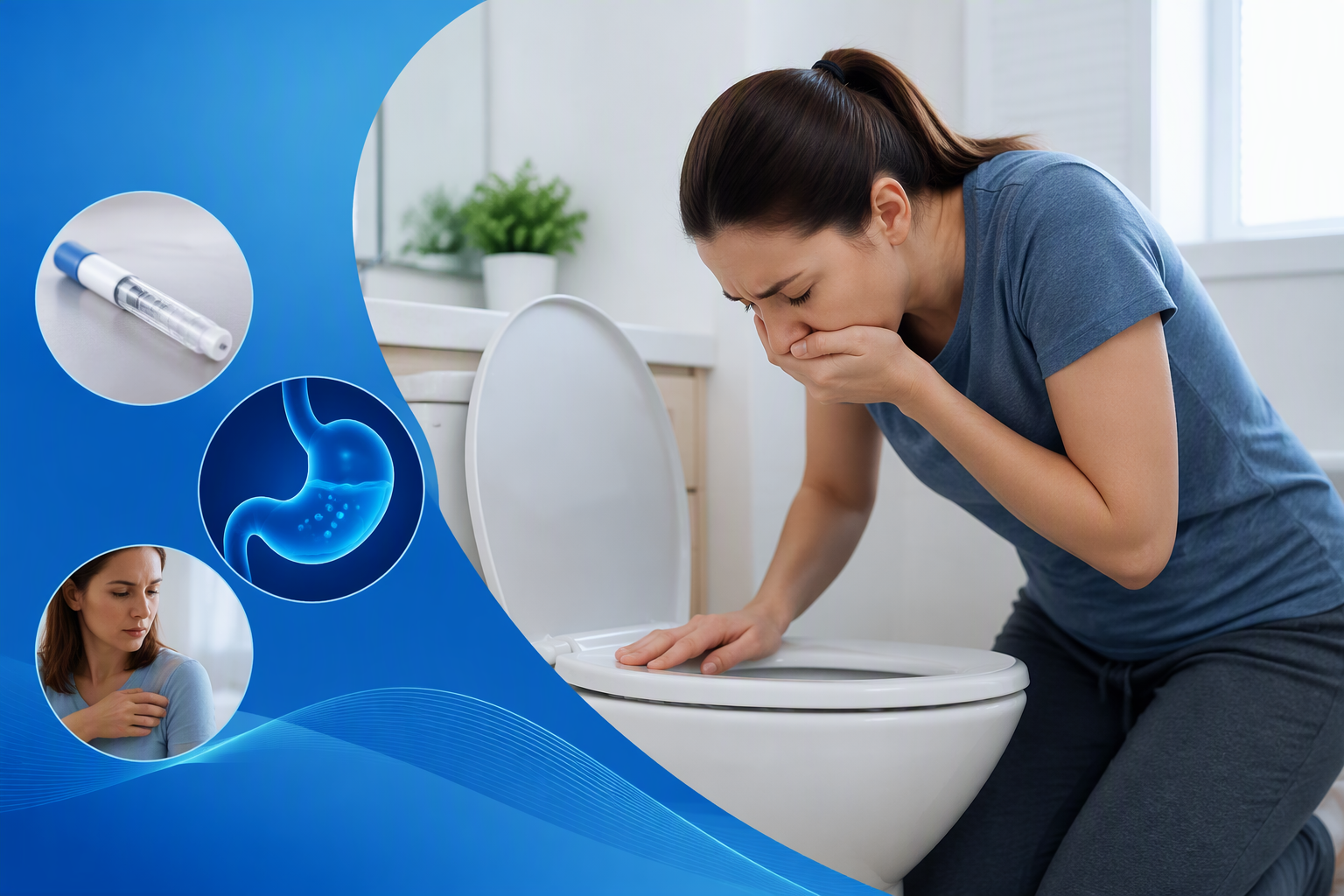
Gastrointestinal symptoms may appear when tirzepatide treatment starts or the dose rises. Dose escalation should not be treated as a deadline; tolerability is part of safe prescribing.
Our week-by-week tirzepatide titration guide explains the role of gradual dose changes. If vomiting starts or worsens after an increase, contact the prescriber before the next injection.
Avoid following universal online instructions to skip, reduce, or stop treatment. The prescriber should consider the symptoms, fluid intake, dose history, other medicines, and relevant health conditions.
What to record before you call
Write down the dose, injection date, and approximate time. Note when nausea and vomiting began in relation to the injection and meals.
Record:
- How often vomiting occurs
- Whether water stays down
- Whether oral rehydration fluid stays down
- Urine amount and color
- Dizziness, weakness, or fainting
- Diarrhea
- Pain location and severity
- Fever
- Yellow skin or eyes
- Blood or dark material in vomit
- Any new medicine or supplement
Recurring vomiting after a dose increase warrants prompt contact even if some water stays down. Do not increase or repeat the dose while waiting for advice.
What not to do on tirzepatide
Do not take an extra dose because you vomited. The injection remains in the body.
Also avoid the following:
- Do not increase the dose without instructions
- Do not split a dose without instructions
- Do not repeat an injection
- Do not borrow another person’s nausea medicine
- Do not rely on food tips for severe or persistent symptoms
- Do not use online anecdotes as safety thresholds
The maximum tirzepatide dose and safety guide explains why higher doses require a prescribed schedule. More medication is not a remedy for vomiting or a safe way to accelerate results.
How long does GLP-1 vomiting last?
There is no single normal duration for vomiting on a GLP-1 medication. The course can differ according to the person, dose, meals, and other health factors.
Mild gastrointestinal symptoms may ease as the body adjusts. That possibility does not make repeated vomiting safe. Instead of waiting for a fixed number of hours or days, assess whether the person can drink, urinate normally, and see a clear improvement.
We suggest three practical checks:
- Can fluids stay down?
- Is urine output close to normal?
- Is the overall pattern improving?
Repeated or worsening vomiting deserves medical review, regardless of how long someone else says their symptoms lasted. An online account cannot show whether that person was dehydrated, had another illness, or needed treatment.
Signs the pattern may be improving
Improvement means more than a pause between episodes. Fluids should remain down, urine output should move toward normal, and symptoms should become less intense.
Signs may include:
- Vomiting stops or becomes less frequent
- Small sips remain down
- Nausea becomes milder
- Urine output recovers
- Urine becomes lighter
- Energy begins to return
- A small bland meal is tolerated
Continue monitoring after the first improvement. Vomiting that returns with each drink or meal is not a stable recovery.
Signs not to wait it out
Do not keep waiting when vomiting continues or returns after every attempt to drink. Fluid intolerance can cause dehydration even when the problem began as a medication side effect.
Seek medical advice for dark or scarce urine, increasing weakness, or a worsening pattern. Pain, fever, jaundice, fainting, confusion, or blood requires urgent assessment.
There is no benefit in enduring serious symptoms until the next routine appointment. The need for care becomes more urgent as fluid loss or warning signs increase.
What to eat and drink after vomiting on tirzepatide
Begin with small, frequent sips rather than a full glass. Pause between sips to see whether the fluid stays down.
An oral rehydration solution may help replace water and salts lost through vomiting or diarrhea. Follow the product directions exactly and do not make the mixture more concentrated.
Once fluids remain down, try a small portion of bland, low-fat food. Eat slowly and stop at the first sign of fullness.
If no fluids stay down, meal advice is no longer enough. Seek prompt medical care.
Fluids to try
Start with a small amount and increase it gradually according to tolerance. Options may include:
- Water
- Clear broth
- An oral rehydration solution
- Another tolerated clear fluid
Avoid drinking a large amount at once. Limit alcohol because it may worsen stomach symptoms and contribute to fluid loss.
If each sip triggers vomiting, contact a clinician promptly rather than continuing to test different drinks.
Foods to try
Once fluids remain down, start with a small serving rather than a full meal. Simple options include:
- Plain toast
- Crackers
- Rice
- Bananas
- Applesauce
- Low-fat soup
- Another bland, low-fat food
Avoid greasy, fried, rich, or very spicy foods while symptoms persist. Return to usual foods gradually as nausea settles.
A short episode after a large meal may improve with this approach. Vomiting that repeatedly follows food or drink needs medical review.
Medicines for nausea need a clinician’s input
Ask the prescriber or pharmacist before adding an over-the-counter or prescription nausea medicine. The appropriate choice may depend on other medicines, pregnancy status, kidney function, and existing health conditions.
A clinician may also need to rule out a more serious problem. Symptom relief alone does not exclude dehydration or an acute abdominal condition.
Never use nausea medicine to delay care for severe pain, blood, confusion, jaundice, fainting, or an inability to keep fluids down.
Vomiting at night or after meals
Nighttime or post-meal vomiting may relate to portion size, fat content, eating speed, and slower stomach emptying. A late, large, high-fat dinner may be especially difficult to tolerate.
For mild symptoms, try an earlier and smaller evening meal. Eat slowly, stop at the first sign of fullness, and remain upright after eating instead of lying down immediately.
These are practical adjustments, not treatment for repeated vomiting. Vomiting food eaten much earlier, marked bloating, worsening pain, or recurring nighttime episodes requires clinician review.
A simple evening plan
While symptoms remain mild:
- Eat a small evening meal well before bed
- Choose lower-fat foods
- Eat slowly
- Stop at the first sign of fullness
- Remain upright after eating
- Record the meal, timing, and symptoms
A log may reveal whether large portions, high-fat foods, or late meals regularly precede symptoms. It also gives the prescriber more useful information.
When the pattern needs assessment
Contact the prescriber if nighttime or post-meal vomiting keeps returning. Mention whether vomit contains food eaten much earlier and whether bloating or pain is increasing.
Seek urgent care for:
- Severe abdominal pain
- A rigid or markedly swollen abdomen
- Inability to pass stool or gas
- Inability to keep fluids down
- Fainting, confusion, or severe weakness
- Blood or coffee-ground-like material in vomit
Do not keep adjusting meal times while warning signs progress.
Dehydration, diarrhea, and kidney risk
Vomiting and diarrhea both cause losses of water and salts. When they occur together, dehydration can develop more quickly.
Possible signs include:
- Low urine output
- Dark urine
- Dry mouth
- Dizziness, particularly when standing
- Weakness
- A fast pulse
- Confusion
Severe fluid loss can reduce blood flow to the kidneys and contribute to acute kidney injury. This does not mean tirzepatide directly causes every kidney problem.
People with kidney disease may need earlier medical advice. Older adults and those taking diuretics or other medicines that affect fluid balance should also tell the clinician about those factors.
When oral rehydration may be reasonable
Oral rehydration may be suitable when small sips stay down and no urgent warning signs are present. Use a prepared product or mix it exactly as directed on the label.
Keep tracking:
- Urine amount and color
- Dizziness
- Weakness
- Vomiting frequency
- Diarrhea frequency
- Fluid intake
Contact a clinician if losses continue despite successful small sips. Oral rehydration supports fluid replacement but does not address the cause of persistent vomiting.
When fluids at home are not enough
Seek prompt care when all fluids come back up. Do not wait for severe thirst, because thirst alone does not reliably show the extent of dehydration.
Very low urine output, fainting, confusion, severe weakness, or rapid decline may mean home rehydration is no longer adequate. Vomiting with diarrhea should also lower the threshold for seeking medical advice.
Severe pain and other warning signs
Mild nausea, fullness, or cramping can occur with stomach upset. Severe or persistent abdominal pain is different and needs assessment.
Vomiting with severe pain may be associated with pancreatitis, gallbladder disease, obstruction, bleeding, or another acute condition. Do not try to identify the cause at home.
Seek urgent care for:
- Severe or persistent abdominal pain
- Blood or coffee-ground-like material in vomit
- Black stool
- Fainting or confusion
- A rigid or swollen abdomen
- Fever with abdominal pain
- Jaundice
- Inability to pass stool or gas
Severe pain may occur with or without vomiting. Its absence does not make other red flags safe, and the absence of vomiting does not make severe pain safe.
Possible pancreatitis signs
Severe, persistent upper abdominal pain may indicate pancreatitis, particularly if it spreads to the back. Nausea and vomiting may accompany the pain.
This pattern needs urgent medical assessment, not meal changes or watchful waiting. Do not wait for every possible symptom to appear.
Possible gallbladder or bile duct signs
Persistent pain in the upper-right abdomen may point to a gallbladder or bile duct problem, especially when accompanied by:
- Fever
- Yellow skin or eyes
- Pale stool
- Dark urine
- Vomiting
Seek urgent medical assessment for this pattern. A low-fat meal or nausea medicine is not a substitute for evaluation.
Questions to ask your tirzepatide prescriber
Use the consultation to get a clear plan. Questions may include:
- Could the timing suggest a dose-related effect?
- What should happen before the next scheduled injection?
- Is assessment needed today?
- Could other medicines increase dehydration risk?
- Do existing health conditions change the advice?
- Which fluids and foods are reasonable now?
- Which symptoms require urgent or emergency care?
At usetemi.com, we view dose tolerance as part of prescribing, not a test of willpower. Clear symptom details help clinicians give safer, more relevant instructions.
FAQ
Is it normal to throw up on GLP-1 medication?
Vomiting can occur with GLP-1 medicines, but repeated vomiting should not be dismissed as routine. A limited, improving episode may allow home monitoring if fluids stay down. Contact a prescriber when vomiting recurs or disrupts drinking. Seek urgent care for fluid intolerance, severe pain, confusion, jaundice, fainting, or blood.
How can I reduce the chance of vomiting on tirzepatide?
Smaller, lower-fat meals may help. Eat slowly, stop at the first sign of fullness, take fluids in small sips, and avoid large or late meals when symptoms are active. These measures cannot prevent every episode or treat dehydration, persistent vomiting, severe pain, or another illness.
How long does GLP-1 vomiting last?
There is no fixed normal duration. Mild symptoms may ease, but the course varies. Focus on whether fluids remain down, urine output is near normal, and vomiting is becoming less frequent. Repeated, worsening, or persistent symptoms need medical review.
Should I take another tirzepatide injection after vomiting?
No. Vomiting does not remove an injection given under the skin. Do not repeat the injection or take an extra dose. Contact the prescriber if vomiting is recurrent, severe, or began after a dose change.
What should I avoid doing on tirzepatide?
Do not increase, split, repeat, reduce, or stop a prescribed dose without instructions from the prescriber. Do not borrow another person’s nausea medicine or use online anecdotes to decide how long symptoms are safe. Food changes alone are not appropriate for severe or persistent vomiting.
Get a dose review before your next injection
If vomiting began or worsened after starting tirzepatide or increasing the dose, contact Temy for an online symptom and dose review before the next injection. Seek urgent medical care now if fluids will not stay down or any warning signs are present.