TL;DR
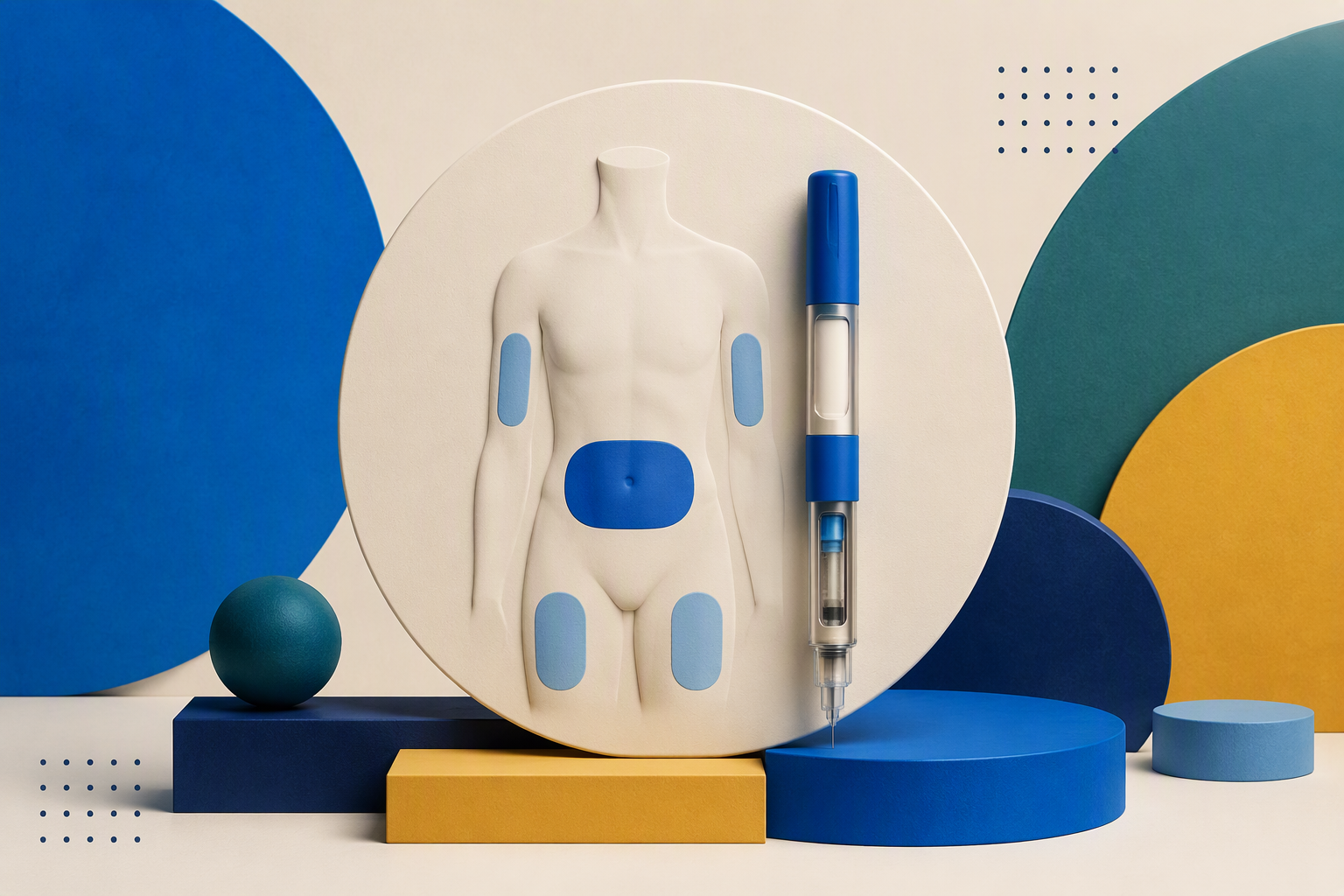
Common GLP-1 injection sites include the abdomen, front of the thigh, and back of the upper arm. The approved areas can vary by medicine and device, so always follow the instructions supplied with the prescription. Choose healthy skin and rotate puncture points rather than returning to the same spot each week.
GLP-1 injection sites and approved areas
“Inject into the thigh” leaves room for confusion. The exact part of the thigh matters, as does the condition of the skin and the location of the previous dose.
Common subcutaneous GLP-1 injection areas include:
- Healthy fatty tissue on the abdomen
- The front or outer-front of the thigh
- The fatty area at the back of the upper arm
Approved semaglutide and tirzepatide injection sites depend on the prescribed product and device. We recommend treating the medication guide and instructions for use as the final authority.
This article focuses on placement and rotation. For preparation, pen operation, leakage, hold times, and sharps disposal, see our safe guide to giving yourself a GLP-1 injection.
Check the label before choosing a site
Before each dose, confirm the medicine name, strength, and device. Different brands may contain the same active ingredient while using different pens, concentrations, or instructions.
Our GLP-1 medication list by active ingredient can help clarify brands, uses, and schedules. If general guidance conflicts with the prescription label, stop and contact the prescribing clinician or pharmacy.
Where to inject a GLP-1 in the stomach
For an abdominal injection, choose healthy fatty tissue away from the navel. Do not inject into the belly button, a tender fold, or damaged skin.
Each product’s instructions may show a boundary around the navel. Follow that diagram rather than estimating from advice written for another medicine.
Avoid areas with:
- Scars or bruises
- Hard patches or lumps
- Moles or rashes
- Irritated or broken skin
- Tender or damaged stretch marks
Returning to one comfortable point every week can irritate the tissue. Moving the puncture point gives the previous area time to recover.
A four-zone abdomen map
For easier tracking, we suggest dividing the usable abdomen into four general zones:
- Upper left
- Lower left
- Upper right
- Lower right
Keep each zone outside the navel boundary shown in the product instructions. Move to a different zone for the next dose and avoid the previous puncture point.
This map is an organizational tool, not a replacement for the medicine’s official injection diagram.
How close can the shot be to the belly button?
Use the minimum distance stated in the instructions supplied with the medication. If the guide is missing or unclear, ask the pharmacy or prescribing team rather than guessing.
Choosing another approved point on the abdomen does not mean the dose is weaker. The key is to remain within the labeled area and inject into healthy subcutaneous tissue.
Where to inject a GLP-1 in the thigh

The usual thigh target is the broad fatty area on the front or outer-front of the upper thigh. Use the product diagram to confirm its boundaries.
Keep away from:
- The groin and inner thigh
- The kneecap and surrounding area
- The hip joint
- Irritated, bruised, or damaged skin
“Upper middle thigh” may be too vague to guide placement. We recommend using the fatty front area shown in the medication instructions, clear of the hip and knee.
Is the inner thigh a GLP-1 injection site?
The inner thigh is not a standard target shown in common semaglutide or tirzepatide instructions. Use the labeled front or outer-front area instead.
If the usual location is sore, select another approved site with healthy skin. Do not move to an unlabeled area simply because it is easier to reach.
A simple thigh rotation map
Each front thigh can be divided into upper and lower zones, provided all zones remain within the product’s approved diagram. A simple sequence might be:
- Left thigh, upper zone
- Right thigh, upper zone
- Left thigh, lower zone
- Right thigh, lower zone
Inspect the skin first. Skip a planned zone if it has swelling, tenderness, bruising, a rash, a scar, a lump, or broken skin.
Where to inject a GLP-1 in the upper arm
The common upper-arm target is the fatty area at the back of the upper arm, between the shoulder and elbow. Confirm that this area is approved for the specific medicine.
Avoid the shoulder cap, inner arm, elbow, and damaged skin. The upper arm can also be difficult to see and reach without twisting.
Why the upper arm can be hard to use alone
Twisting may make it harder to position the device, maintain contact, and confirm that it remains within the intended area. Some product instructions recommend having another person administer an upper-arm injection.
Follow the directions for the exact device. Our self-injection resources can support general technique, but instructions for one pen should not be applied automatically to another.
How to rotate GLP-1 injection sites each week
Rotation means choosing a new puncture point. It does not mean an entire body area becomes unavailable after one injection.
We recommend keeping a simple log that includes the date, medicine, dose, body area, zone, and any skin reaction. Before recording a dose, check the prescription carefully. Our semaglutide dosage chart explains why milligrams, units, and dosing schedules should not be treated as interchangeable.
Repeatedly using one point may contribute to:
- Bruising
- Soreness
- Irritation
- Hard or thickened skin
A four-week rotation example
One possible rotation is:
- Week 1: Lower-left abdomen
- Week 2: Lower-right abdomen
- Week 3: Left front thigh
- Week 4: Right front thigh
This is only an example. Any labeled site with healthy skin may be appropriate. People who find one body area easier to use can often rotate among different points within that approved area.
Can insulin and a GLP-1 use the same body area?
They may be used in the same general body region when both prescriptions permit it, but they should not share the same puncture point or be injected immediately beside each other.
Follow both products’ instructions. The care team can explain appropriate spacing and help create a rotation plan for multiple injectable medicines.
Does the injection site change pain, nausea, or weight loss?
There is no established “best GLP-1 injection site for weight loss.” We do not recommend choosing the stomach, thigh, or arm as a way to speed up results.
Approved sites are intended to deliver medicine into tissue under the skin. Correct technique, consistent use, and following the prescription matter more than favoring one body area.
Nausea affects the body more broadly and is not simply a skin-site reaction. Personal reports that one location prevented nausea do not establish that the site caused the difference.
For more information about how these medicines work, read our GLP-1 receptor agonist monotherapy guide.
Which GLP-1 injection site hurts least?
No single location is most comfortable for everyone. Sensation can also vary from one dose to the next.
Choose healthy skin that is easy to reach, and avoid sore, bruised, hard, scarred, or irritated areas. A site that felt painless once should not become the permanent injection point.
Can a site change the speed of weight loss?
We have not seen a sound basis for presenting one labeled site as a shortcut to faster weight loss. Treatment response can depend on the prescribed medicine, dose, duration, health conditions, eating patterns, activity, and other individual factors.
Questions about slow progress or dose changes belong with the prescribing clinician, not an injection-site experiment.
When not to use an injection site
Do not inject into skin that is:
- Bruised, swollen, or tender
- Hard, red, or unusually warm
- Infected, draining, or broken
- Scarred
- Covered by a mole or rash
- Increasingly painful
Select another labeled location if the previous point remains sore or hardened. Contact the prescribing clinician or pharmacy if redness spreads, pain worsens, drainage appears, or a lump persists.
Trouble breathing, swelling of the face or throat, faintness, or a widespread rash may require urgent medical attention.
What if the last site is still sore or hard?
Use another approved site with healthy skin. Do not puncture, massage, or reuse the affected area.
We recommend recording the reaction and asking the care team about any lump or irritation that persists or worsens.
What if medicine leaks onto the skin?
Do not repeat the dose unless the prescribing clinician or pharmacist specifically advises it. Repeating an uncertain dose could result in receiving too much medication.
Check the product instructions for device-specific advice. Our self-injection guide also explains what to record after a problem.
Semaglutide and tirzepatide site questions
Semaglutide and tirzepatide products can differ in brand, concentration, device, and instructions. Always check the label supplied with the exact prescription.
Are semaglutide and tirzepatide injection sites the same?
Common labeled areas often include the abdomen, thigh, and upper arm, but that does not make every product’s instructions identical.
Confirm the approved locations in the medication guide. Directions for one brand should not be assumed to apply to another.
How often are semaglutide or tirzepatide injected?
Many injectable semaglutide and tirzepatide products used for diabetes or weight management follow a weekly schedule. Exact schedules and missed-dose instructions can differ.
Follow the prescription label. Do not repeat, move, or skip a dose based solely on general guidance.
Where can I get help with my specific pen?
Start with the medication’s instructions for use, then contact the prescribing clinician or pharmacy if anything remains unclear.
At Temi, we help patients keep medications and prescription support in one place. Pen-specific instructions should guide storage, preparation, needle handling, hold time, and missed doses.
FAQ
Does changing injection sites affect tirzepatide?
Changing among the labeled sites should not reduce tirzepatide’s effect. Rotation changes the puncture point, not the prescribed dose. Use healthy skin and follow the device instructions.
How long does it take to lose 20 pounds on Ozempic?
There is no fixed timeline. Results vary with treatment, starting weight, health conditions, eating patterns, activity, and side effects. Ozempic is not approved solely for general weight loss. Ask the prescribing clinician to set an appropriate goal and review progress.
Where are common injection sites for insulin?
Common areas may include the abdomen, thigh, upper arm, and buttock area, but the insulin’s instructions control. If insulin and a GLP-1 are used in the same general region, keep their puncture points separate and ask the care team about spacing.
How often do you inject semaglutide?
Many injectable semaglutide products are used weekly, but the exact schedule, dose-escalation plan, and missed-dose rules depend on the prescription. Follow the label and do not take an extra dose without professional guidance.
Get help with your GLP-1 prescription
Check the medication guide before the next injection. If the site map, pen, or label is still unclear, contact your Temi clinician or pharmacy now for prescription-specific guidance.