TL;DR
Prescription expiration dates can refer to two different deadlines: the validity of a prescriber’s order and the shelf life of the medicine itself. An expired order may prevent a pharmacy from dispensing another refill, while an expired medication may no longer have supported potency, quality, or safety. We recommend following the earliest date on the label and checking with a pharmacist when anything is unclear.
Prescription expiration dates: The short answer
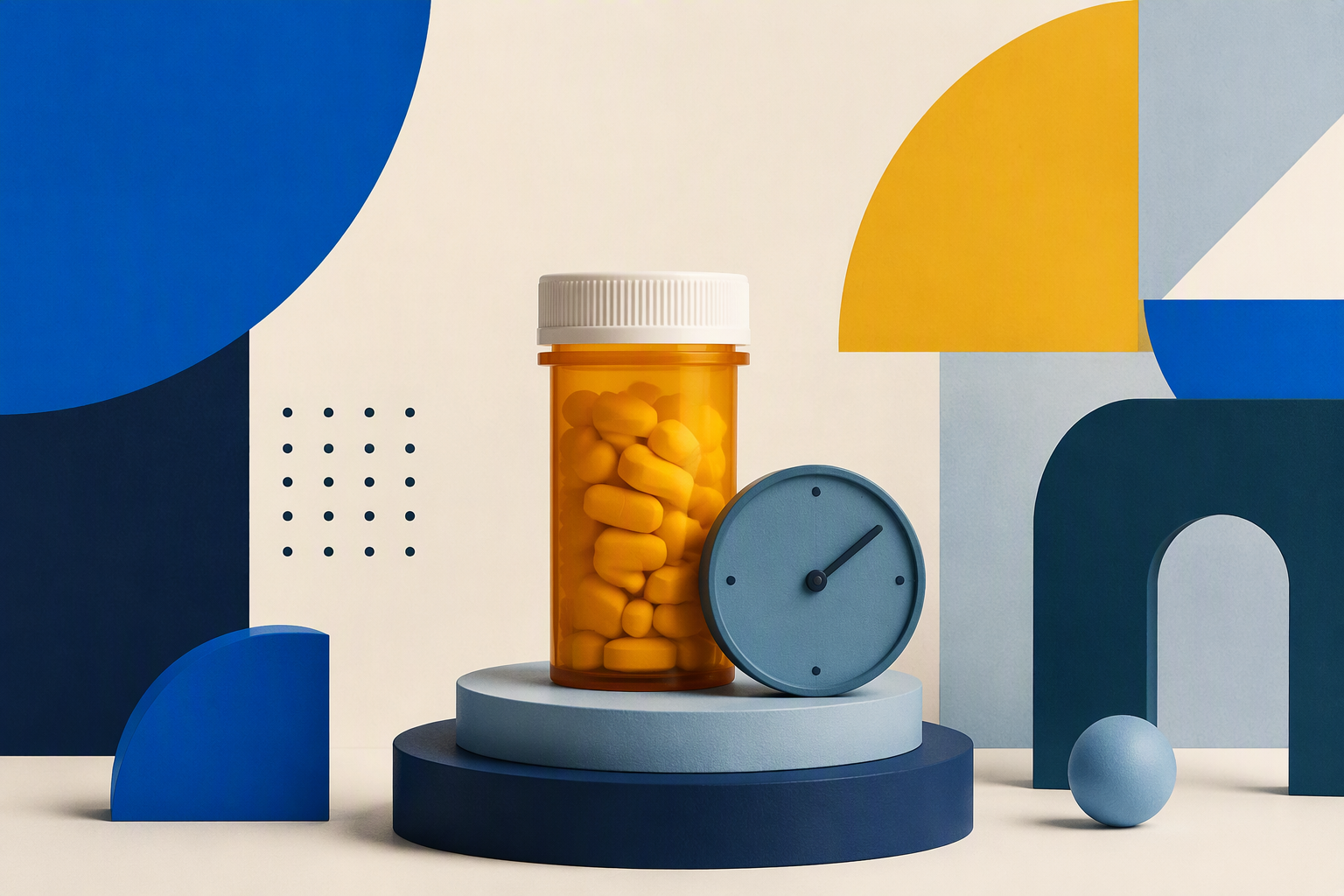
Two separate clocks may apply to a prescription:
- Medication shelf life: The period during which the manufacturer supports the drug’s quality when it remains in the specified packaging and storage conditions.
- Prescription order validity: The period during which a pharmacy may legally fill the prescriber’s order.
An expired prescription order usually requires renewal or a new order, even when the medicine’s manufacturer expiration date is still in the future. A refill count on a bottle or in an app does not necessarily mean the order remains valid.
Expired medicine is a separate issue. There is no single grace period that applies to every drug. The medicine, dosage form, packaging, storage history, and reason for treatment all matter.
Medication expiration and prescription expiration are not the same
A medication expiration date concerns the product itself. A prescription expiration date concerns the pharmacy’s authority to dispense it.
That distinction explains why a pharmacy may decline a refill that still appears in an account or on an old label. The pharmacy may need to confirm the order’s age, remaining refills, applicable laws, insurance requirements, or availability.
If an order has expired, ask whether the prescriber can renew it. Our guide to online prescription refills explains when a refill may be enough and when a new prescription is needed.
Why refills can remain after the order expires
A refill count records how many fills were originally authorized. It does not extend the order indefinitely.
Prescription transfers can also be restricted. The medication, location, order status, and transfer history may affect whether another pharmacy can accept it. We recommend asking the receiving pharmacy before starting a transfer.
Controlled-substance refill limits
Controlled substances follow stricter prescribing and dispensing rules than many other medications. Limits differ by drug classification and may also depend on federal and state requirements.
For example, alprazolam, commonly sold under the brand name Xanax, is a controlled substance. A refill shown on an old bottle does not prove that the pharmacy can dispense it. The pharmacist must review the current order and applicable rules.
Manufacturer date, pharmacy discard date, and beyond-use date
Several dates may appear on one medicine:
| Date | Set by | What it covers |
|---|---|---|
| Manufacturer expiration date | Manufacturer | The product under its tested packaging and storage conditions |
| Pharmacy discard or use-by date | Dispensing pharmacy | The medicine as packaged and dispensed |
| Beyond-use date | Compounding pharmacy or qualified preparer | A specific compounded preparation |
| After-opening or first-use date | Manufacturer or pharmacy | The product after opening, puncturing, or first use |
A pharmacy may assign an earlier date when it repackages or compounds a medicine. When dates conflict, we recommend following the earliest applicable deadline unless the dispensing pharmacist gives different instructions.
Why the pharmacy date may come first
The manufacturer’s testing generally applies to the original container and specified storage conditions. Moving tablets into a prescription vial can change the conditions under which the medicine is kept.
Heat, moisture, direct light, damaged packaging, and repeated opening can also affect a product. That is why the pharmacy’s discard date may come before the date printed on the original package.
Why compounded medicines need their own rule
A compounded medicine has a beyond-use date for that specific preparation, container, and storage method. Follow the dispensing pharmacy’s label rather than borrowing instructions from a commercial product with the same active ingredient.
If the medicine comes in a multi-dose vial, ask whether a separate first-puncture deadline applies.
How to read a date such as 10/2026
A label that says “EXP 10/2026” identifies October 2026 as the expiration month, but the exact interpretation can depend on the label wording and product instructions. If no day is shown, ask the pharmacy to confirm when the product should be discarded.
A specific pharmacy discard date, first-use deadline, or compounded beyond-use date may arrive sooner. Never guess when a date is faded, covered, or split between labels.
Can you take medicine after the expiration date?
We do not recommend assuming that expired medicine is safe or effective. After the supported date, the manufacturer no longer guarantees that the product remains within its tested specifications.
Some medicines may lose strength. Others raise concerns about contamination, sterility, packaging, or device performance. Appearance is not a reliable test: normal color, smell, or clarity cannot confirm potency or proper storage.
Ask a pharmacist or prescriber before using expired medicine, especially when missing treatment could cause harm.
Storage can shorten the usable life
A printed expiration date assumes that storage and packaging requirements were followed. A medicine may need to be discarded sooner after:
- Excessive heat or freezing
- Exposure to moisture or direct light
- A broken seal or cracked container
- Leakage or device damage
- Storage outside the labeled temperature range
A future expiration date does not reverse storage damage. A refrigerated injection left in a hot car, for example, may require replacement even when its carton date has not passed.
There is no universal grace period
A sealed tablet is not equivalent to an opened eye drop, mixed liquid, or injectable medicine. Each has different stability and contamination concerns.
Research involving medicines stored under controlled conditions cannot establish the condition of a bottle kept in a bathroom, bag, garage, or vehicle. Home storage history matters.
Drugs that need extra caution after expiration
Extra care is warranted when dependable strength, sterility, or device performance is essential.
| Product type | Main concern |
|---|---|
| Insulin and other dose-sensitive medicines | Uncertain strength may affect treatment |
| Epinephrine auto-injectors | Reliable delivery is critical during an emergency |
| Nitroglycerin | Reduced strength could affect urgent treatment |
| Mixed liquid antibiotics | Stability and contamination may change after preparation |
| Eye drops | Sterility may change after opening |
| Biologics, vaccines, and sterile injections | Temperature control and package integrity are essential |
| Compounded medicines | Limits depend on the specific preparation |
Do not delay emergency care while investigating a date. Use current emergency medicine when available and follow emergency instructions.
Why liquids, eye drops, and injections need more care
Potency is only part of the concern. Opened liquids and sterile products may also have contamination or sterility limits that end before the package expiration date.
When the instructions require it, write the first-use or opening date on the container.
What to do with 10-year-old Xanax or alprazolam
Do not rely on decade-old alprazolam. The bottle cannot confirm the medicine’s current strength, storage history, appropriate dose, or suitability for a present medical need.
Do not share it or use it as a substitute for current care. Take-back programs are generally the preferred disposal option for unused controlled medicines.
GLP-1 expiration and storage rules
GLP-1 medicines do not share one universal storage rule. Tablets, multi-dose pens, single-dose devices, and compounded vials can have different refrigeration, room-temperature, and first-use instructions.
Check the exact product label every time. Use the earliest applicable deadline: the printed expiration date, the in-use limit, the room-temperature limit, or the compounded beyond-use date.
Semaglutide products
Ozempic, Wegovy, and Rybelsus contain semaglutide, but they come in different forms and have different handling instructions. Do not apply the storage rules for one product to another.
Tirzepatide products
Mounjaro and Zepbound contain tirzepatide. Instructions may differ by product and device presentation, so check the current carton and pharmacy label rather than relying on an older supply.
Compounded GLP-1 medicines
Follow the dispensing pharmacy’s beyond-use date, concentration, container, and storage directions. Commercial product instructions do not establish the shelf life of a compounded preparation.
Frozen, overheated, leaking, cloudy, or damaged pens
Hold the dose and contact the pharmacy after freezing, overheating, or an unknown temperature event. Do not use a leaking, cracked, discolored, or particle-containing product when its instructions require an intact device and clear solution.
What to do when the date has passed
Use this five-step check:
- Identify the date. Determine whether it is an expiration, discard, beyond-use, first-use, or prescription-order date.
- Review storage. Check for heat, freezing, moisture, light, broken seals, or damage.
- Consider the product. Be especially cautious with urgent medicines, liquids, eye drops, injections, biologics, and compounded products.
- Call the pharmacy. Ask whether a refill, transfer, replacement, or new order is possible.
- Request renewal if needed. Contact the prescriber or a licensed care service.
Do not double a later dose unless the product instructions or a clinician directs it. Our prescription refill support can help identify the next practical step.
At Temi, licensed clinicians assess whether a requested medicine and dose remain appropriate. A clinical review does not guarantee a prescription.
A low-cost refill check
Before paying for another appointment, ask whether the fill was blocked by an expired order, missing refills, insurance requirements, stock, or transfer restrictions. Then compare the full cost of care, including the visit, medicine, testing, and follow-up. Our cash-pay pharmacy guides can help.
FAQ
How long after a prescription expires can it still be used?
First clarify whether the pharmacy order or the medicine has expired. An expired order may require renewal, while expired medicine has no universal grace period. Ask the pharmacy to review the exact product and date.
Which medicines require the most caution after expiration?
Use particular caution with insulin, epinephrine, nitroglycerin, eye drops, mixed liquids, sterile injections, biologics, vaccines, and compounded medicines. These products may depend on reliable strength, sterility, or device performance.
What does an expiration date of 10/2026 mean?
It identifies October 2026 as the expiration month. Because wording and product instructions can vary, confirm the exact discard point with the pharmacist if no day is printed.
Is it safe to take 10-year-old Xanax?
We recommend against taking it without a current pharmacist or prescriber review. Its strength, storage history, current appropriateness, and interaction risks cannot be confirmed from the old label.
How should expired medicine be discarded?
Use a drug take-back program when available. Follow product-specific disposal instructions for controlled medicines, injection devices, and sharps. Used needles belong in an approved sharps container, not household recycling.
Check your refill options
If your pharmacy says the prescription order has expired, use Temi’s online prescription refill service to review your renewal options, likely costs, and next steps with a licensed clinician.