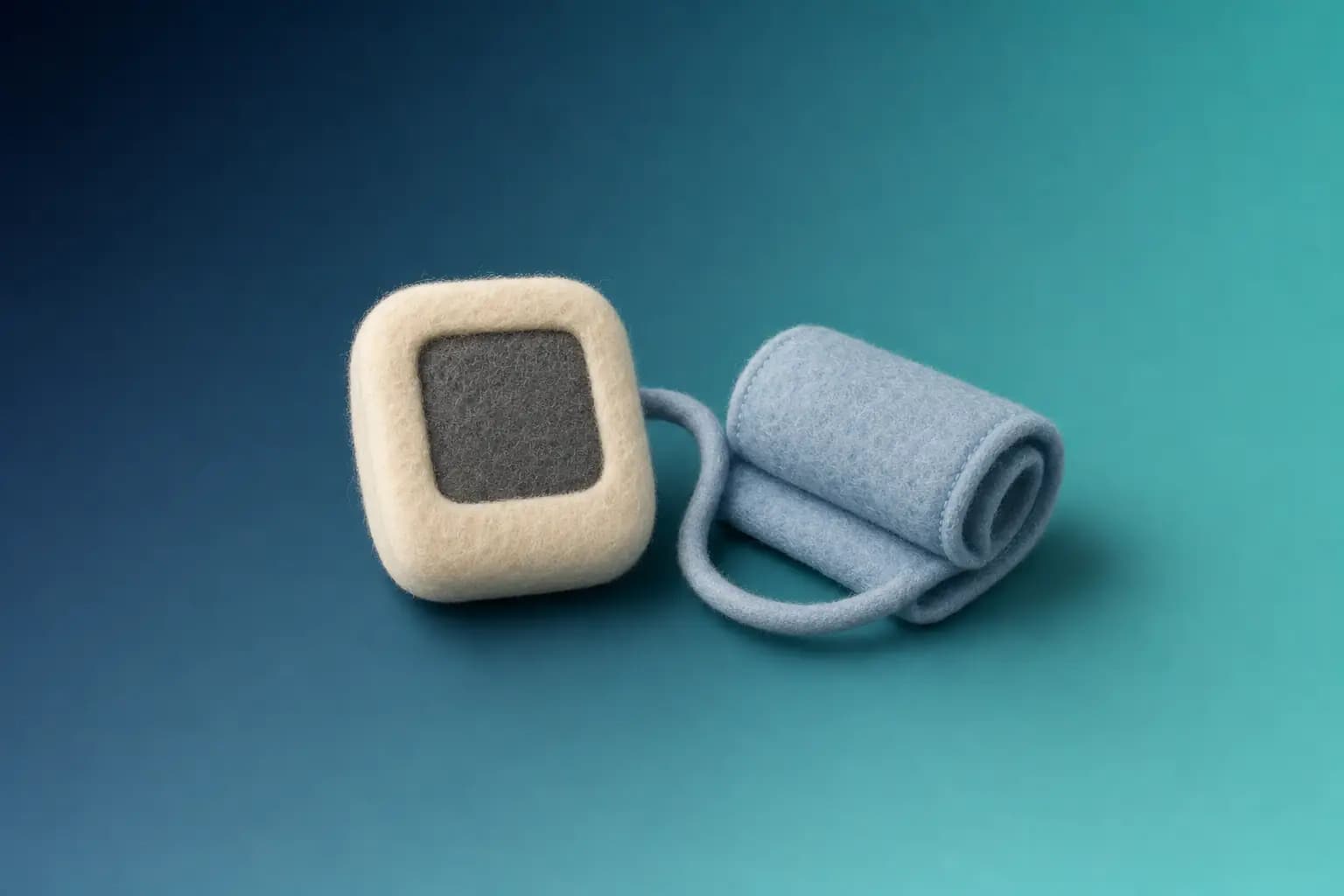
Four AI tools were asked about 324 home monitors. The answers were already on free public lists.
The short answer: in a study presented at the American Heart Association's Hypertension Scientific Sessions, Google Gemini correctly identified whether a home blood pressure monitor was validated 85.8% to 90.7% of the time, and Microsoft Copilot, ChatGPT and Perplexity AI did so 63% to 82.7% of the time, Healio reported. The registries that hold the answer are free. The results are preliminary and not yet peer-reviewed.
What Healio reported
On November 2, Maddy Grieco at Healio covered poster TH125 by Anna Soriano, MD, a resident at the University of Montreal, and colleagues. The abstract is not public yet: the AHA's October 8 release says it will be published on November 17, 2026, in the journal Hypertension.
A monitor counts as validated, in the AHA's words, "when independent, third-party testing has proven it gives consistently accurate blood pressure readings." The AHA's 2025 blood pressure guideline recommends using a validated home monitor, according to the release.
How the study worked
From April to May 2026, the researchers tested 324 monitors, Healio reported: 145 validated upper-arm and wrist devices drawn from the STRIDE BP, Validate BP and Hypertension Canada listings, and 179 nonvalidated devices from Medaval. The 324 also included top sellers on Amazon in Canada, Australia and the United States.
Each tool got three questions per device: a general one, one pointing it to the validation listings, and that one again with a one-word answer required. The team retested 20% of devices with mixed results, on different computers and days, according to the AHA release.
What it found
- Accuracy varied by tool. Gemini was correct 85.8% to 90.7% of the time, depending on the question; the other three ranged from 63% to 82.7%.
- Validated devices were the hard part. All four tools were less accurate on validated monitors than on nonvalidated ones, the AHA says, and all four "misidentified various home blood pressure monitors as not meeting clinical standards even though the AI tool was verifying against the independent registries that list only validated blood pressure monitors."
- Answers changed on a retest. Asked the same question on another day or computer, the tools "often produced a different answer."
"We found that most AI tools performed only slightly better than if you had flipped a coin for each question," Soriano said in the release. Soriano explained the failure: "In many cases, the AI tools found the blood pressure monitor was listed within an official website, however, it seems AI was not able to interpret being listed on the registry as proof of validation."
What the registries hold
The lists are short enough to read. STRIDE BP's home-use list, generated on November 3, 2026, is a five-page PDF:
- Upper-arm monitors: 351 models on the market, and 86 no longer sold. Of the 351, 229 are marked as equivalent or identical to a validated device, which STRIDE BP says means they "have not been validated" themselves.
- Wrist monitors: 55 on the market (25 of them marked equivalent or identical), and 16 no longer sold. STRIDE BP marks wrist devices "Generally not recommended due to inferior accuracy to upper-arm devices in practice and issues with correct use according to instructions."
On its home page, STRIDE BP says it has approved 551, and recommends as preferred only 294, "of the over 5,000 electronic blood pressure monitors currently available on the market." That puts approved monitors at no more than about 11% of the market, and preferred ones at no more than about 5.9%. A monitor picked at random from that market is far more likely to be missing from the list than on it.
At STRIDE BP, at least three members of its Scientific Advisory Board review each validation study, per its listing principles. In the US, validatebp.org lists devices that an all-volunteer Independent Review Committee found to meet criteria the AMA formalized, according to the AMA.
What the study does not show
- It is preliminary. The AHA notes that conference abstracts "are not peer-reviewed."
- It is a snapshot. The authors say results "are likely to change as AI technology continues to improve with time," and private browsing "could not fully prevent language model training of the AI tools."
- The cause is unclear. The authors "could not determine exactly why" validated devices were harder.
- We can't yet split the errors. Until the abstract is out, we don't know how many wrong answers called a validated monitor unvalidated, or the reverse.
What the sources suggest
The AHA release points people to their clinician and to validatebp.org. Keith C. Ferdinand, MD, vice chair of the 2025 guideline, who was not involved in the study, said in a video the AHA provided to the press, as quoted by Healio: "Simply going to the more popular AI tools at this point is not the best way to make that determination." Ferdinand added: "One simple way of determining whether or not you have a valid machine is bring it to the doctor’s office, or your nurse practitioner’s clinic, especially with the first visit."
Where Temi fits
Who checked this, and can I see it? That is a fair question for any care you get online too. At Temi, a licensed physician reviews your request and makes the decision, and a decision not to prescribe is part of that review. You see a flat review fee before you pay, and you pick the pharmacy. Temi does not check or sell blood pressure monitors.
Sources were read on November 3, 2026. The abstract is due November 17, 2026; update this post once it is public. STRIDE BP regenerates its list on each download, so its counts will change.