

TL;DR
The 2026 semaglutide patent expiration headlines apply to specific countries, including India and China. They do not establish an FDA-approved U.S. generic launch in 2026. U.S. access depends on product-specific patents and exclusivities, FDA review, litigation, commercial launch plans, manufacturing capacity, and pharmacy stock.
Semaglutide patent expiration: the short U.S. answer
Publication date: September 21, 2026
Last reviewed: September 21, 2026
The short U.S. answer is no: the cited 2026 reports do not establish an FDA-approved generic semaglutide with a verified U.S. pharmacy launch that year.
“Generic semaglutide in 2026” usually refers to patent events in countries such as India and China. IQVIA reported that semaglutide protection would begin expiring in several countries in 2026 while continuing into the early 2030s in many others.
A foreign patent event does not authorize U.S. sales. Nor does it prove that a manufacturer has FDA approval, has resolved relevant U.S. patent issues, or can supply American pharmacies.
No single semaglutide patent expiration date guarantees:
- FDA approval
- A commercial launch
- Pharmacy inventory
- Legal substitution
- A lower cash price
We recommend that cash-pay patients plan around current refill prices rather than projected patent dates. Our 2026 guide to semaglutide costs without insurance explains the payment and pricing factors that matter now.
Will generic semaglutide be available in the United States in 2026?
The sources reviewed for this article do not establish a verified FDA-approved U.S. generic launch in 2026.
An approved generic requires a product-specific FDA record. A development announcement, foreign authorization, active-ingredient supply agreement, pending application, or tentative approval is not the same as final FDA approval.
Tentative approval generally means the FDA has completed much of its review, but the product cannot yet receive final approval or enter the market under the applicable conditions. Even final approval does not prove that a manufacturer has launched or that pharmacies have stock.
A reliable U.S. launch claim should identify:
- The FDA application and reference product
- The dosage form and strength
- Final approval status
- The manufacturer and launch date
- Actual U.S. pharmacy availability
Why reports give different expiration dates
Reports may be discussing different legal rights. One date can concern the semaglutide molecule; another may apply to a formulation, dose, treatment method, oral absorption system, pen, or injector.
Jurisdiction matters too. A patent may expire or face a challenge in one country while remaining in force elsewhere.
Ozempic, Wegovy, and Rybelsus all contain semaglutide, but they are separate approved products. Each has its own dosage form, labeling, regulatory application, and patent record.
Generic semaglutide in 2026: which countries does the claim cover?
The clearest 2026 claims concern selected markets outside the United States. C&EN reported that patents were due to expire in countries including India and China, where generic manufacturers were preparing products. IQVIA also identified Canada, Brazil, and Turkey among the countries with patent expirations beginning in 2026.
These reports do not mean every country will approve and launch a generic on the same date.
| Market | Reported patent position | What still needs confirmation |
|---|---|---|
| United States | The cited sources do not identify a 2026 U.S. generic launch | Product-specific FDA approval, patent position, launch, and stock |
| China | A semaglutide patent event was reported for 2026 | Local authorization, remaining rights, launch date, and supply |
| India | Patent expiration was reported for 2026 | Regulatory review, manufacturing readiness, launch, and distribution |
| Canada | IQVIA included Canada among markets with expiration beginning in 2026 | Product-specific rights, authorization, and commercial availability |
| Other markets | Dates vary by country and legal right | Local patent records, regulatory status, pricing, and supply |
Patent projections are not approval records. Even after relevant protection ends, production and distribution determine whether patients can obtain the medicine.
Why a foreign patent expiration does not set the U.S. timeline
Patent rights are territorial. An expiration in India or China does not remove a U.S. patent.
Drug approvals are also jurisdiction-specific. A company that wants to sell an approved generic in the United States must obtain the required FDA approval for that product.
Foreign approval does not create:
- FDA approval
- U.S. substitution status
- Routine eligibility for U.S. pharmacy dispensing
- General permission to import the product for personal use
A generic sold abroad may have a different label, strength, device, or regulatory file. A U.S. pharmacist cannot treat foreign authorization as FDA approval.
What the 2026 headlines leave out
A relevant patent can expire while no manufacturer is ready to launch. An applicant may still need regulatory approval, a compliant production site, enough active ingredient, injector capacity, packaging, and distribution agreements.
Other patents may remain. A company might clear a molecule patent but still face rights related to formulation, dosing, treatment methods, or injection devices.
Litigation and settlements can also change commercial timing. Regulatory action and legal permission to launch are related but separate questions.
Ozempic, Wegovy, and Rybelsus do not share one simple patent date
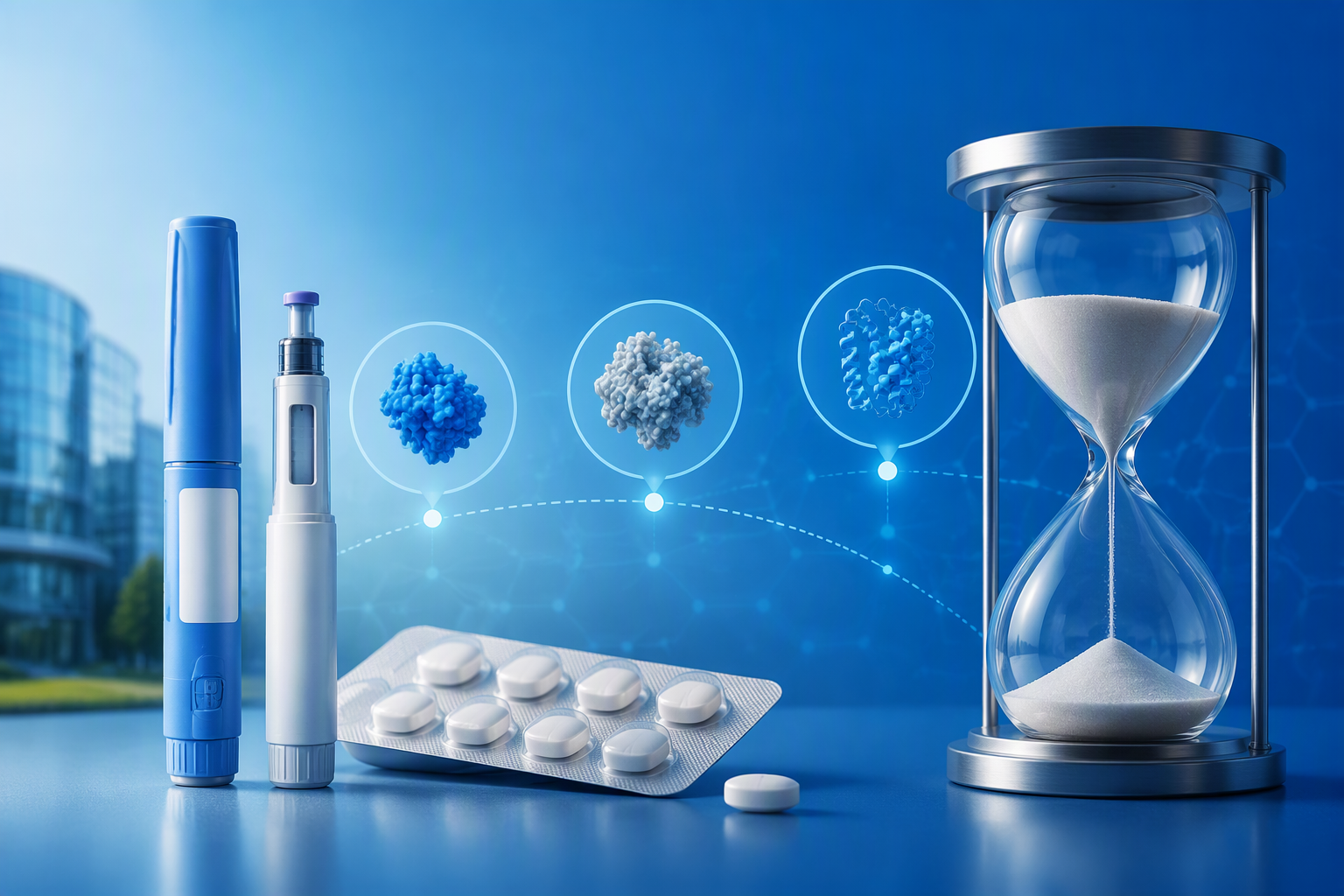
Although all three contain semaglutide, they are not the same approved product for prescribing or substitution.
| Product | Dosage form | Primary type of use | Delivery method | Potential patent focus |
|---|---|---|---|---|
| Ozempic | Injection | Type 2 diabetes | Prefilled pen | Ingredient, formulation, dosing, treatment methods, and device |
| Wegovy | Injection | Chronic weight management | Prefilled injection device | Formulation, doses, treatment methods, and device |
| Rybelsus | Tablet | Type 2 diabetes | Oral tablet | Ingredient, oral formulation, and absorption technology |
Ozempic and Wegovy both use injectable semaglutide, but their labels, strengths, dosing, and regulatory applications differ.
Rybelsus is an oral tablet designed to deliver semaglutide through the digestive tract. Approval of a generic injection would not authorize substitution for an oral product.
Active-ingredient and formulation patents
An active-ingredient patent can protect claims involving the drug substance. Other patents may cover how that ingredient is prepared, delivered, or used, including:
- Formulation components
- Product strengths
- Dosing schedules
- Treatment methods
- Tablet design
- Oral absorption technology
- Storage or stability features
A generic applicant evaluates the patents relevant to its proposed product. The expiration of one patent does not remove every product-specific right.
Pen, injector, and device patents
An injectable drug-device product requires more than semaglutide production. A manufacturer must develop a delivery system that administers the intended dose and meets applicable quality and usability standards.
It also needs a dependable supply of pen components. Limited device capacity can restrict finished-product supply even when active ingredient is available.
Device patents may create separate disputes or require different designs. The loss of an ingredient patent therefore does not produce an interchangeable semaglutide pen overnight.
Patent expiration is one step, not a pharmacy launch date
A simplified U.S. path can involve several stages:
- A patent or exclusivity changes. A right expires, is challenged, or becomes subject to a settlement.
- A manufacturer submits an application. The filing identifies the reference product, dosage form, strength, manufacturing process, and proposed label.
- The FDA reviews the product. Review may cover sameness, quality, bioequivalence, facilities, labeling, and device issues.
- Patent notice or litigation occurs. Certain patent certifications can lead to notice and a lawsuit.
- The FDA takes regulatory action. The agency may grant tentative or final approval or request more information.
- The manufacturer sets or obtains a launch date. Litigation, settlements, supply constraints, or business decisions may affect timing.
- Distributors and pharmacies receive stock. Inventory may lag behind a launch announcement.
FDA exclusivity is separate from patent protection. Patents arise under patent law, while regulatory exclusivity arises under federal drug law. Either may affect when a generic can be approved or launched.
The five dates patients should check
We recommend checking five dates before treating a headline as a refill plan:
- The relevant patent or regulatory exclusivity end date
- The FDA final approval date
- Any applicable court judgment or settlement date
- The manufacturer’s commercial launch date
- The pharmacy stock date
The first date rarely answers the full question. For practical access, pharmacy inventory often matters most.
How the FDA evaluates a proposed generic
A conventional generic application generally must match the reference drug’s active ingredient, strength, dosage form, and route of administration. Its labeling usually follows the reference product, subject to permitted differences.
The applicant must also demonstrate product quality and reliable manufacturing. Bioequivalence testing evaluates whether the proposed generic meets the applicable comparison standard.
The required evidence depends on the product. An oral tablet and an injection do not necessarily use the same testing approach. Combination drug-device products may also require engineering and usability work to support accurate dosing and correct use.
FDA Orange Book patents and exclusivities in plain terms
The FDA Orange Book connects approved drug applications with listed patents and regulatory exclusivities. A drug may have several entries because different rights cover different formulations, uses, or features.
A listed expiration date does not guarantee that a patent will remain enforceable until that date. A patent may be challenged, narrowed, disclaimed, settled, or found not to block a particular proposed generic.
Likewise, the earliest listed expiration does not promise a launch. Other patents, exclusivities, approval requirements, or supply barriers may remain.
When reviewing an Orange Book record, match:
- Proprietary and active-ingredient names
- Application number
- Dosage form and route
- Strength
- Patent number and expiration
- Patent use code
- Regulatory exclusivity
We do not recommend combining entries for Ozempic, Wegovy, and Rybelsus into one date. Start with the exact prescribed product.
Patent protection versus regulatory exclusivity
Patents are property rights granted under patent law. They may cover ingredients, formulations, methods, or devices.
FDA exclusivities arise under federal drug law and may protect certain approvals, studies, or qualifying uses for defined periods.
These protections can overlap, but they may begin and end at different times. One can remain relevant after the other ends.
Why the earliest and latest dates can both mislead
The earliest date may apply to only one aspect of the drug, leaving formulation, method-of-use, or device patents in place.
The latest date can also give an incomplete picture. It may cover a narrow use that a proposed generic does not seek at launch, or the patent may be challenged or settled.
The commercially meaningful date depends on the proposed product, patent certifications, FDA status, court record, and launch plan.
Generic versus compounded semaglutide: approval, substitution, and labeling
Compounded semaglutide is not an FDA-approved generic. It should not be described as generic Ozempic or generic Wegovy.
| Issue | FDA-approved generic | Compounded product |
|---|---|---|
| Premarket approval | FDA approves the application before marketing | The finished product does not receive generic approval |
| Reference-product comparison | Must meet applicable generic approval standards | Is not approved as equivalent to Ozempic or Wegovy |
| Labeling | Uses FDA-reviewed labeling | Uses labeling supplied under applicable compounding rules |
| Manufacturing | FDA application and manufacturing requirements apply | Requirements vary by facility type and governing law |
| Substitution | Depends on FDA status and state law | Is not automatically substitutable as an approved generic |
Federal law distinguishes traditional patient-specific compounding under Section 503A from outsourcing facilities operating under Section 503B. The requirements are not interchangeable.
Drug-shortage status can affect whether certain copies of approved products may be compounded, but it is not the only consideration. Current FDA policy, court decisions, product details, state law, and professional standards may also matter.
The FDA has distinguished semaglutide base from salt forms such as semaglutide sodium and semaglutide acetate. In an April 27, 2023 FDA letter concerning semaglutide salt forms, the agency addressed whether those forms met federal bulk-substance conditions. We recommend confirming the form a product contains rather than relying on the word “semaglutide” alone.
What changes when FDA shortage status changes
A change in FDA shortage status can affect shortage-based compounding conditions. The practical result depends on the facility, product, prescription, timing, agency policy, and any applicable court orders.
A statutory requirement is not the same as temporary enforcement discretion. A transition period is not the same as a permanent exemption.
A licensed clinician and dispensing pharmacy should assess the current rules and the specific product.
Questions to ask a clinician or pharmacist
Before accepting a product described as generic, alternative, or off-brand, ask:
- Is it FDA-approved or compounded?
- What form of the active ingredient does it contain?
- What concentration appears on the label?
- Which licensed pharmacy dispenses it?
- Is it legally and clinically substitutable for the prescription?
- Does its device or dosing method differ from the prescribed product?
Will semaglutide prices fall after a patent expires?
Possibly, but a lower active-ingredient cost does not guarantee a low pharmacy price. Finished semaglutide products still require manufacturing, testing, filling, pens or tablets, packaging, shipping, and distribution.
Other factors include:
- Number of approved competitors
- Final approval and launch timing
- Production scale
- Injector and component supply
- Distribution and pharmacy contracts
- Dosage-form availability
- Strength-specific inventory
Price terms also differ. List price is not the same as an insurer’s negotiated price, a discount-card quote, or a cash-pay patient’s final cost.
FDA approval may precede broad supply or a meaningful price change. Our analysis of a possible Ozempic price drop in 2026 and 2027 explains why approval and patient savings may arrive at different times.
Why the first generic may not create the largest savings
A first entrant may have limited production capacity and face little immediate competition. Additional launches can increase price pressure, while more stable active-ingredient and injector supplies may improve availability.
None of these developments guarantees a particular discount. A credible forecast should identify the country, product, date, supply assumptions, and expected number of competitors.
What cash-pay patients should watch
For each refill, we suggest checking:
- FDA final approval notices
- Manufacturer launch statements
- Pharmacy stock for the prescribed strength
- Current cash price and refill quantity
- Pen, concentration, and dosing differences
Quotes are only comparable when the products match. A tablet supply, branded pen, and compounded vial may have different doses, labels, and dispensing terms.
How to check a generic semaglutide claim before a refill
We use six checks:
- Country: Does the claim concern the United States?
- Product: Does it name Ozempic, Wegovy, Rybelsus, or another product?
- Patent: Which patent or exclusivity changed?
- Regulator: Is there an identifiable FDA application and final approval?
- Launch: Has the manufacturer confirmed commercial sales?
- Stock: Can a licensed U.S. pharmacy dispense the prescribed form and strength?
The word “generic” is not enough. Look for the applicant, approval status, dosage form, route, strength, and launch evidence.
Warning signs include:
- Citing only a foreign patent date
- Describing active-ingredient production as a finished-product launch
- Calling a compounded product an FDA-approved generic
- Citing research-use material as a prescription drug
- Naming no manufacturer or pharmacy availability
- Grouping oral tablets and injection pens together
We do not recommend delaying or changing treatment because of a patent headline. Refill, substitution, and dosing questions belong with a licensed clinician or pharmacist.
A quick claim check
Ask four questions:
- Which country does the date cover?
- Does the report name a product or only semaglutide?
- Is the event a patent change, FDA approval, commercial launch, or shortage update?
- Can a licensed U.S. pharmacy confirm stock?
If a key answer is missing, the claim is not enough to support a refill decision.
Primary sources to verify
Useful primary records include:
- FDA Orange Book
- Drugs@FDA
- FDA Drug Shortages database
- Dated FDA compounding notices
- U.S. and foreign patent offices
- Federal court dockets
- Settlement disclosures
- Manufacturer launch statements
At usetemi.com, we focus on what patients can act on: the exact prescription, refill status, current price, and dispensing path. Patent forecasts provide context, not pharmacy inventory.
FAQ
How long until semaglutide becomes generic in the United States?
No single date guarantees a U.S. generic launch. Ozempic, Wegovy, and Rybelsus have separate product records, while FDA review, patents, exclusivities, litigation, manufacturing, and launch plans can all affect timing.
Will a generic version of semaglutide be available in 2026?
The sources reviewed here do not establish an FDA-approved U.S. generic launch in 2026. The main reports concern patent events in countries including India and China. Approval or launch abroad does not establish U.S. availability.
Does Wegovy insurance coverage depend on patent expiration?
No. Coverage depends on the health plan, benefit design, labeled indication, employer choices, prior authorization requirements, and current policy. Patent expiration alone does not require a plan to cover Wegovy.
Is compounded semaglutide the same as generic semaglutide?
No. A compounded product is not an FDA-approved generic and is not automatically substitutable for Ozempic, Wegovy, or Rybelsus. Its ingredients, concentration, labeling, and dispensing framework require separate review.
Do tirzepatide or Mounjaro patent dates change the semaglutide timeline?
No. Tirzepatide is a different active ingredient with separate products, applications, patents, exclusivities, and manufacturing constraints. A tirzepatide patent event does not authorize a generic semaglutide product.
Check your next semaglutide refill
Patent headlines should not set a refill date. Confirm the exact product, current price, prescriber requirements, and pharmacy supply.
Use Temi to keep your medications and refill details in one place, then ask a licensed clinician or pharmacist to review any proposed substitution.