


Everyone who tries to fix healthcare is solving the wrong problem.
Tuning payment models. Building AI tools for hospitals. Making prices transparent. Smart people are doing real work — but it feels like the needle keeps moving in the opposite direction as healthcare gets more and more expensive.
Healthcare is a credence good: the people buying it can't evaluate its necessity, quality, or fairness. This single fact is the reason behind the trillion-dollar layers of administrativa, billing codes, prior authorization, utilization review, PBMs, denial management.
But something new is happening. Patients are walking into visits with diagnoses exceeding their doctor's judgment. With every new ChatGPT user, the information asymmetry at the root of healthcare grifting fades. And there is a playbook for what comes next.
We built Temi because you shouldn't need permission to get the care you know you need. We are building the safest & simplest action layer of healthcare: works with any pharmacy; no appointments; no insurance slowdowns. This is how we create an abundant, affordable superstandard of care for all.
Foundations for Building This Company
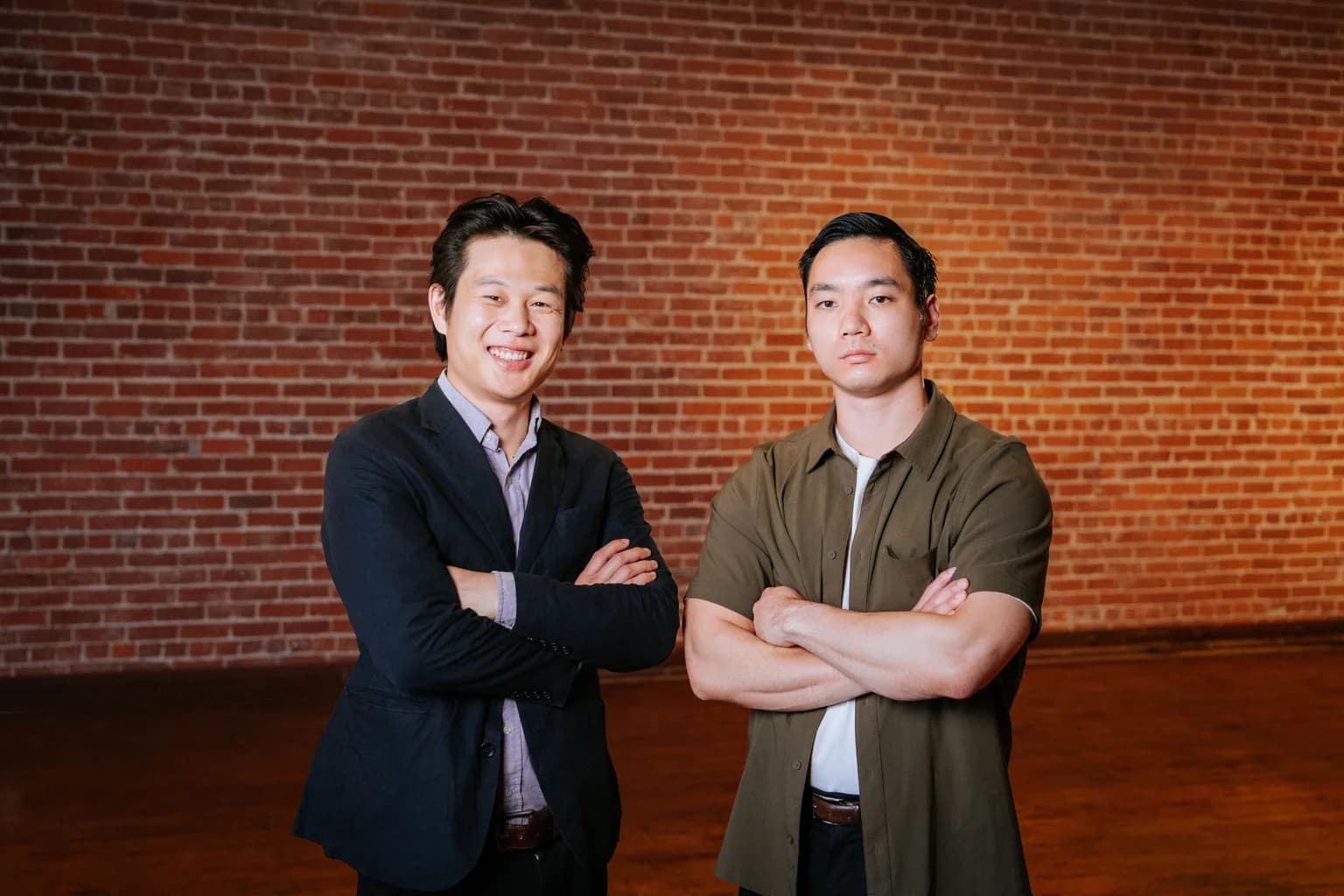
Live with urgency. Every passing day without a universal right to decent healthcare carries a human cost. I'm dedicating my life to realizing this. My cofounder picked up his entire life to come to San Francisco to build this through nights and weekends. Our founding clinical partner puts in day hours on top of his night shifts to urgently manifest this new reality.
My path to healthcare began in St. Louis, where my youngest brother's struggle with epilepsy fueled a passion to learn how medicine could help improve people's lives.
I've spent many years caring for patients at critical moments of their lives, across busy urban emergency departments in the San Francisco Bay Area. I'm now energized to build a future where healthcare is more accessible, effective, and humane.
— Kevin Brandstetter, M.D., Founding Clinical Partner
Never work without curiosity. What is the root of $935,000,000,000 in annual healthcare waste?1 Why can't we build the world's best healthcare system? Starting with why puts us in the position to take on the most ambitious goals with confidence. I hope that in reading this, you too are inspired to see the future with audacity.
Progress is not inevitable. Only through razor focus on building a specific future can we hope to achieve it. We have learned to say no to countless good opportunities to pursue the great things that really matter. every. single. day.

Healthcare progress suffers from solutioning the wrong problems
The most expensive healthcare system. The least effective healthcare system. Brilliant people are working to make healthcare better. But the incremental progress is far from enough.
Fighting incentive structures is playing against the house
"Fee-for-service is the root of the problem." Okay, so realign incentives to support health outcomes instead of procedure volume. Value-based care works abroad, so why not in the US?2 Fifteen years of non-results tell the story.
The Center for Medicare & Medicaid Innovation has tested dozens of alternative payment models since 2010. No real savings, with any improvements attributable purely to employees working harder.3
Or consider Haven — the Amazon/Berkshire Hathaway/JPMorgan collab run by Harvard surgeon Atul Gawande, one of America's most respected voices on healthcare reform. Despite having the negotiating power of 1.2M lives, they accomplished nothing.4
Incentive reform is not a bad idea. But it is idealistic in the complex reality that is healthcare today. Healthcare institutions are structurally advantaged to protect their revenue models.
Productivity improvements don't benefit consumers
AI already provides immense value to the healthcare system. Ambience AI scribing saves clinicians hours of documentation every day.5 OpenEvidence is used daily by over 40% of US physicians.6
But follow the money. What happens to the time saved by technology? More patients scheduled. More billing. More revenue. The patient's bill doesn't go down. Wait times don't go down.
The buyer of tools is the health system. The person who needs better care is the patient. The principal–agent problem manifests as health systems keeping their extra AI profits a secret from patients in the dark.
Transparency is good but misses the point
Cost Plus Drugs sells >2,200 medications, demonstrating that drug prices can be radically lower when you get around the intermediaries.7 GoodRx solved the cash part of drug price discovery for consumers.8 Turquoise Health publishes negotiated rates across payers, mostly to the benefit of hospitals.
This work matters. It makes parts of the system more efficient.
But the trillion-dollar administrative apparatus of healthcare waste is untouched. Nearly ten administrators for every one doctor.9 You could make every price in healthcare perfectly transparent tomorrow and not eliminate the need for these administrators. The problem they're managing isn't price opacity.
In an industry rife with problems, working backwards is the only path to reaching endgame
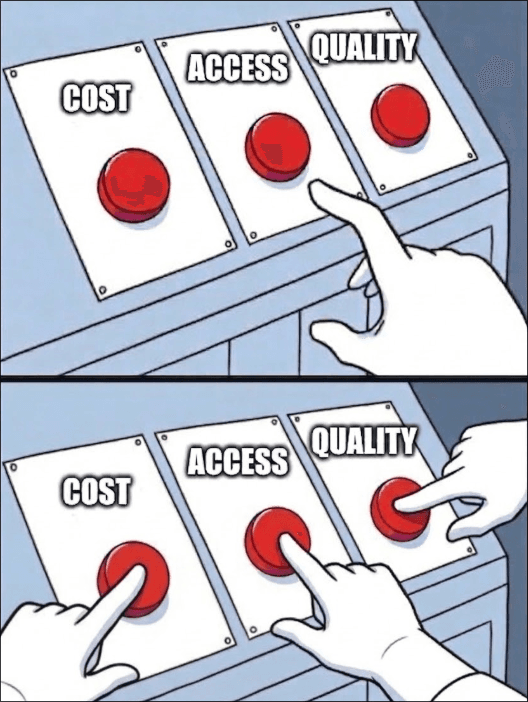
Healthtech builders today are building forward from where we are — optimizing revenue cycle management, streamlining existing workflows, shaving margins off the same broken processes. But if you want to realize universal infinite healthcare,10 you need to focus. Only by starting at the end and working backwards can one figure out what it takes to get to endgame.
The perfect industry for grift makes honest work hard
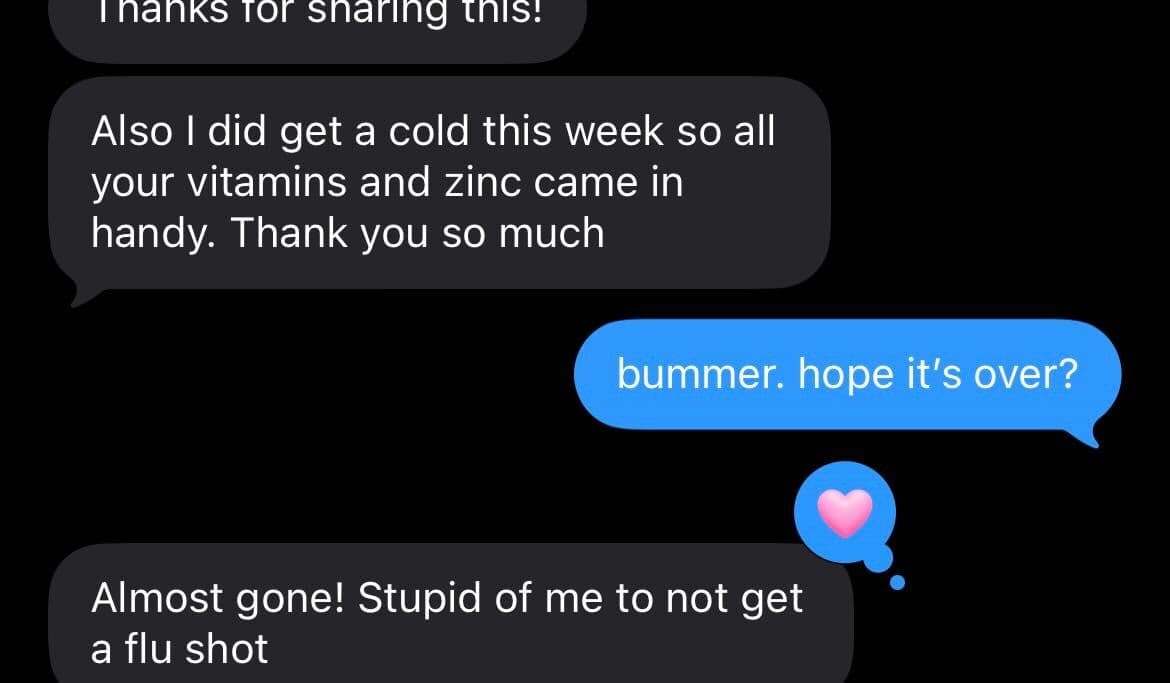 I'm not a doctor. And clearly, neither is my friend who really enjoyed my placebo care plan. But I still got the credit for her immune system kicking in.
This is the root of the problem. Over half of American adults read below a 6th-grade level. How can anyone expect patients to not mix up bupropion and buspirone? You go to the doctor, and you give credence to them because they're a doctor™. Maybe they've learned something from their CMEs. Or, they're still following the same standard of care from 20 years ago. Being a discerning buyer of healthcare is hard when you neither know how much you need nor how good your care was.11 In economics, this makes healthcare a credence good.
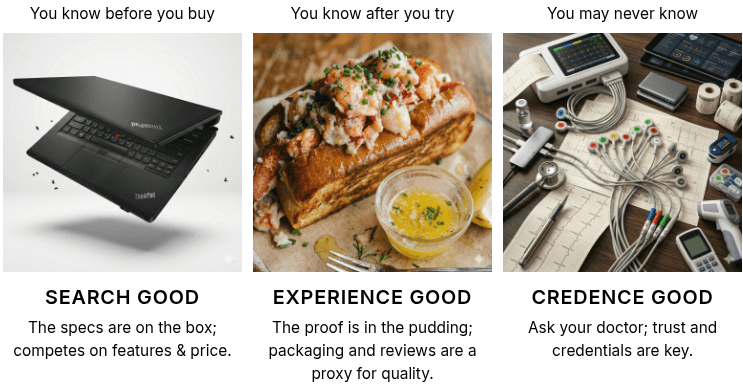
Another example of a credence good market is home repairs: A plumber pipe-splains to you that you need copper instead of PEX because of your water's mineral content. They finish the job and your water doesn't leak anymore (you suspect). If it bursts again in two years, you have no clue if it was their fault, or if you even needed the extra-primo copper tubes in the first place. You were unable to judge before, during, and after.
Healthcare is the ultimate credence good. You don't know the quality of the clinician's judgment. So you can't price it. Even after the care — if a treatment didn't work, can you blame the doctor? Maybe you're just unlucky. Or maybe the care plan was actually terribly risky and you're the lucky 1%. You'll never know.
In sectors with credence goods — home repairs, education, used car sales — market dynamics exploit the judgment and information asymmetry by jacking up prices. In healthcare, when third-party administrators, employers, health systems, and government institutions haphazardly come together to attempt to manage the credence of care quality, you invent the US healthcare system. Customer ignorance is too profitable to not exploit.
With this lens, understanding healthcare inefficiency becomes radically simple. All of billing. The entire PBM apparatus. Third-party administrators. Even licensing requirements for prescription refills. These are all functioning as the same thing: credence management. Who should we buy from? What drug should we use? What's covered? How much should we charge? These are all credence-layer questions. What most call healthcare waste exists to manage a problem that patients legitimately cannot manage: evaluating the need and quality of the care they receive.
The three previous failure modes become obvious:
- Incentive tuning makes credence goods, definitionally hard to value, even harder to understand. In a free market, no matter how you architect the system of trading credence goods, the ones who have information will exploit those who don't.
- Productivity tools disproportionately help those with information, only widening the knowledge gap. The credence dynamic is untouched.
- Price transparency streamlines the non-credence layers of healthcare. Drugs are search goods. Procedures are experience goods. The decision-making for the prescription is the credence good. Price transparency is good but sidesteps the core of credence grift: clinical need and quality judgments.
The US healthcare system is the inevitable result of an under-planned credence goods market. So long as healthcare remains a credence good, this is what you get.
Until now.
AI disrupts the nature of healthcare purchasing
In 2026, it's hard for an AI company to not be building "the AI doctor". The catch: AI doctor already exists. GPT-5 outperforms doctors on HealthBench — the most comprehensive benchmark of real-world clinical tasks.12 Med-Gemini scores 91.1% on the US medical licensing exam.13 The only thing preventing middle schoolers from releasing their own AI doctors is a fortnight of context engineering and compliance paperwork.
Patients are already walking into visits having talked to ChatGPT about their symptoms — and clinicians are recognizing that the judgment asymmetry has flipped. The patient now has more information than the provider, refined by soon-to-be-AGI-level medical judgment.
This is making patients impatient. They want the doctor's visit less and less — and want direct access to procedures, labs, and drugs, more and more. The only thing stopping them is pharmacy plexiglass reinforced by the force of law.
Credence good industries transform into barbell markets
This decredencification shift doesn't hit all of healthcare equally. You have to split healthcare into two parts.
Inpatient care is 17% of total healthcare spending: hospitals, emergency rooms, surgeries, ICUs, cancer treatment. Physically scarce. Often life-or-death. Judgment asymmetry is strong while you're incapacitated, unconscious, and mid-panic attack. This will remain a credence good because AI does not solve situational judgment or information asymmetry (unless you've already handed power of attorney to OpenClaw).
Outpatient care is almost everything else: routine doctor visits, prescriptions, chronic disease management, mental health, labs, imaging, preventive care. Over 50% of the $15,474 spent per American per year.14 Millions of AI believers are already walking into their visits confidently knowing what they need. But the infrastructure hasn't caught up: you can self-diagnose a sinus infection in thirty seconds, but getting the script for the antibiotics is still a pain. This credence barrier of medical judgment is collapsing, moving the bottleneck to care delivery.
We've seen the barbell play out in legal services, another credence good market. LegalZoom commoditized services that once cost thousands of dollars — LLC formation, basic wills, simple contracts. But if you're doing a Fortune 500 merger, you're still paying top dollar for brand-name attorneys to work their magic.
There is a playbook to win in this transformation
Healthcare is not the first credence market where consumers gained the ability to evaluate what was previously opaque. In every industry that goes through this shift, three paths emerge with wildly different outcomes.
Data access — a struggle to survive. Angi's List tried to solve information asymmetry in home repairs by charging homeowners a subscription to read reviews for plumbers, roofers, and electricians. They spent $83 acquiring members who paid $21 per year.15 Capturing almost none of their value created, it took twenty years and $252M in losses before they saw their first profit.
Steering — solid business. Zillow captures ~$2.6B in revenue out of the $100B+ in annual commissions it helps generate.16 This comes from the over 230 million monthly visitors coming to the site for free price estimates (formerly an expensive and hard-to-judge credence). Zillow's estimates are average within 7% of close value. That 7% is the residual credence — the gap that keeps agents employed and Zillow stuck selling leads instead of owning the transaction.
Services — thriving margins. Auto repair was once completely opaque. When OBD-II diagnostic ports were mandated in every car, the market asymmetries in auto diagnostics were set to evaporate. AutoZone bet big on making diagnostics free: Driver pulls in with a Check Engine light. Tech walks out with scanner, plugs into the universal OBD-II. "Code P0135. Upstream O2 sensor. $45 for the part to fix it." The Check Engine light creates a moment of intent and AutoZone becomes the one to capture it most efficiently. AutoZone does a healthy 19B in revenue with 52% margins.17
When credence dissolves, value migrates from "I know something you don't" to "I have something you need." In healthcare, AI is making the diagnosis free. What remains scarce (but now finally possible) is the full experience — knowing what you need and getting it with no cracks to fall through. The companies that deliver this will define the next era of healthcare.
We are razor focused on bringing universal infinite healthcare to life
You've taken the same medication for three years. You moved states. Your prescription lapsed. To get it renewed, you book an appointment three weeks out, take time off work, and pay $??? for the privilege of hearing a doctor agree with you.
On Temi, you tell us what you need. A doctor reviews your request to make sure you're getting the safest version of what you asked for. The prescription goes to any pharmacy you choose. Done.
AI makes knowing what you need free. Temi makes getting it frictionless: healthcare that starts with what you need and fights to get it to you.
It takes a village to bring new ideas to life
Thank you to all of our early patients who waited on our mailing list for us to become available in your state. It brings me great joy to finally serve you.
I'm so excited to formally welcome Dr. Kevin Brandstetter to our team, bringing nearly two decades of clinical experience from Kaiser Permanente.
Extra notable thanks to:
- Matthew Woo from Summer Health for his extremely generous advice and introduction to Tim Foran.
- Ahmed Al-Bahar for his world-class product coaching on getting the most out of every user interview.
- Alex Liu from Harvard/Wharton, our toughest advisor by far.
- Brian Bernert for incredibly detailed feedback and coaching.
- Jay Lee and Ali Kapadia for reviewing early drafts of this essay.
Need an Rx refill? Skip your next PCP visit: usetemi.com
Footnotes
-
Shrank, Rogstad & Parekh, "Waste in the US Health Care System," JAMA (2019). $760B-$935B annual waste across six domains. ↩
-
Commonwealth Fund, International Health Care System Profiles. Japan, Singapore manage credence at government level. ↩
-
CBO, "Federal Budgetary Effects of CMMI" (2023). Net +$5.4B federal spending over first decade; 6 of ~50 models showed savings. ↩
-
Christensen Institute, "Why Haven Failed" (2021). No cohesive strategy; couldn't consolidate bargaining power across dispersed populations. ↩
-
Ambience Healthcare & Alpine Physician Partners, "Save Clinicians More Than 3 Hours Per Day" (2024). Charting: 4.7 to 1.2 hrs/day. ↩
-
OpenEvidence, "$210M Round at $3.5B Valuation" (2026). 40%+ of US physicians daily; 1M+ consultations/day; 10K+ hospitals. ↩
-
Hussain et al., "Drug Pricing Stewardship from Cost Plus," PharmacoEconomics (2024). Est. $8.6B Medicare Part D savings. Catalog. ↩
-
GoodRx, FY2025 Results (Feb 2026). $797M revenue; MACs declining ~20% YoY. ↩
-
Himmelstein et al., "Health Care Administrative Costs," Annals of Internal Medicine (2020). 34.2% of US spending ($812B) = admin. BLS via PNHP: 3,200% admin growth vs 150% physician growth, 1975-2010. ↩
-
Pande & Yoo, "Infinite Healthcare: What's It Worth?" (a16z, 2025). AI removes clinician-availability constraint; pricing shifts from per-unit to per-patient access (Jevons Paradox). ↩
-
NCES, "Health Literacy of America's Adults" (2006): 12% proficient health literacy. PIAAC 2023: ~54% of adults read below 6th-grade level. ↩
-
Arora et al., "HealthBench," arXiv (May 2025). GPT-5 SOTA; unassisted LLM > unassisted physician. OpenAI. ↩
-
Saab et al., "Capabilities of Gemini Models in Medicine," arXiv (Apr 2024). Med-Gemini 91.1% on MedQA. Google Research. ↩
-
CMS, National Health Expenditure Data (2024). $5.3T total, $15,474/capita. Outpatient categories >50% of NHE. ↩
-
Angi's List — founded 1995; first profit 2015. See Dolan & Israeli, HBS Case 9-517-016 (2016). CNBC. ↩
-
Zillow, FY2025 Results. ~$2.6B revenue, 230M+ uniques. Zestimate error: ~2% listed, ~7% off-market. Zillow Offers shut down 2021, $881M loss. Thompson/Stratechery. ↩
-
AutoZone, FY2025 Q4 Earnings. $18.9B revenue, 52.6% gross margin. OBD-II standardized 1996: CARB fact sheet. ↩